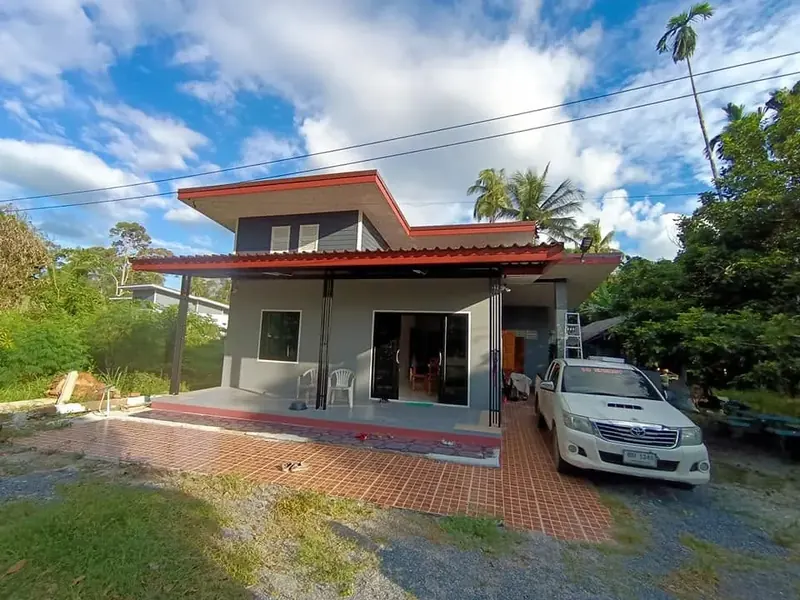
Southern Thailand gets frequent thunderstorms all year round, so asking about lightning is perfectly reasonable — and it's worth discussing clearly before you sign a contract.
Do solar panels attract lightning?
Not in the way many people think. Lightning mainly picks its path based on the height and shape of a structure. Panels mounted flat on the roof barely add to the height of the house, so they don't meaningfully change the chance of that house being struck.
What does change is that when lightning strikes nearby, the house now has more electronic equipment that can be damaged by a power surge.
The real damage comes from surges, not direct strikes
Direct strikes on panels are very rare. The far more common case is a strike close by — a power pole or a tree a few dozen meters away — which sends a voltage surge along the wiring into the house.
The component damaged most often is the inverter, because it has the most delicate electronics in the system and is the most expensive item after the full set of panels.
What people overlook is that a surge can come in two ways: along the grid supply side and along the cables from the panels on the roof. Protection is needed on both sides, not just one.
Protection that should be in your quote
- A DC surge protection device on the panel side, installed in the combiner box before the inverter.
- An AC surge protection device between the inverter and your home's main electrical panel.
- A grounding system that bonds the mounting structure and every panel frame together and connects them to earth.
- Cable routing that avoids large loops, which pick up induced voltage when lightning strikes nearby.
When comparing quotes from several installers, check whether these items are listed. If they aren't, you can ask for them to be added — they're inexpensive compared with the system itself and protect its most delicate equipment.
If your house already has a lightning rod
If the house already has a lightning protection system, the solar array must be designed to sit within its zone of protection, with proper separation between the panel structure and the lightning conductors.
Connecting the panel structure directly to the lightning protection system without a proper design can send lightning current into the solar system instead of into the ground — which is worse than having nothing at all.
Does insurance cover it?
Lightning damage is generally not covered by manufacturer warranties, because it counts as an act of nature (force majeure). Check whether your home fire insurance policy covers this equipment.
You should also tell your insurer that a solar system has been installed, because changes to the electrical system that aren't declared can later be grounds for a claim to be rejected.
Frequently asked questions
Should I switch off the breakers when a storm comes in?
Not if surge protection is installed on both sides. The system is designed to operate normally in this kind of weather. Switching breakers on and off frequently actually wears them out faster than normal.
Do surge protection devices wear out?
Yes. They degrade a little every time they operate. Good models have a status window showing whether they're still working or need replacing — it's one of the things we check every time we go up to clean the panels.
Related services and areas
Keep reading
- How Often Should You Clean Solar Panels, and Why Is the South Different?Rain washes off dust, but not bird droppings or algae — and a small patch of grime cuts output more than a thin film of dust spread across the whole panel.
- 7 Things to Check Before Choosing a Solar Installer in Southern ThailandThe cheapest price is not necessarily the best value, and the most expensive is not necessarily the best. Here is what to look at instead.
- Does Solar Still Work During a Power Cut?Many people only find out at their first power cut that the house goes dark as usual, even with bright sun on the roof. Here's why, and what you need if you want power to keep running.
- Solar Water Pumps for Rubber Plantations and Shrimp Ponds: How to ChoosePumps run during the day, exactly when panels produce power, and their timing is flexible — which makes them one of the most cost-effective uses of solar.