Solar Panel Installation in Krabi
Solar panel installation in Krabi for Ao Nang hotels, Koh Lanta accommodation and the oil palm mills of Ao Luek and Nuea Khlong, with site surveys by appointment.
Solar work in Krabi at a glance
Work in Krabi falls into two worlds that barely overlap. On the tourism side, Mueang Krabi has large hotels around Ao Nang and guesthouses in town, Koh Lanta is an island district where many properties close for long periods during the monsoon, and Khlong Thom has small guesthouses around the hot spring waterfall and the Emerald Pool, many deep in the forest and far from the main power lines.
On the industrial side are Ao Luek and Nuea Khlong, large oil palm areas with palm oil mills, loading yards and several palm industry plants. These plants run continuously in the daytime and use power at a level where PEA grid-connection approval takes longer than the installation itself, and steam, humidity and palm bunch dust make panels dirty quickly. Nuea Khlong also has a coastline with small-scale fishing and aquaculture ponds.
Who solar suits in Krabi
Krabi has both a tourism industry and large oil palm plantations. For resorts and guesthouses, electricity is a major cost, because air-conditioning, water pumps and pool systems run all day. For beachfront properties we choose salt-resistant materials from the design stage, because salt air corrodes metal much faster than it does inland.
How the work differs across districts in Krabi
Krabi has two clearly separate levels of work in one province. On one side are the hotels and guesthouses around Ao Nang and Koh Lanta, where installation has to be split into phases so guests are not disturbed. On the island, many properties close for long periods during the monsoon, so the system cannot be sized from a year-round average. On the other side are the palm oil industrial plants in Ao Luek and Nuea Khlong, which use power at a level where getting grid-connection approval from the PEA (Provincial Electricity Authority) takes longer than the installation itself.
Services that match work in Krabi
- Solar for hotels and resortsHotels around Ao Nang and accommodation on Koh Lanta, where electricity is a major cost.
- Solar for oil palm plantationsThe large oil palm plantations and loading yards of Ao Luek and Nuea Khlong.
- Solar for factoriesPalm oil mills that run continuously through the day.
- PEA grid-connection paperworkLarge plants in Nuea Khlong, where the approval process decides the real start date.
- Hybrid systems with battery backupGuesthouses in Khlong Thom and end-of-line bays on Koh Lanta with frequent voltage dips.
Who we most often install for here
- Resorts and guesthouses
- Palm plantations and processing plants
- Homes
Examples of systems we have installed
Real site photos from our installation team — homes, factories and farms across several provinces in Southern Thailand. Tap a photo to see it full size.
If you would like to see a real installation near you, contact us and we will arrange a visit if the owner agrees, or browse all 468 project photos.
Krabi Province
- Services in this area
- Surveys, installation and after-sales care
- Site survey
- Site surveys by appointment
- Travel charge
- Any travel charge is confirmed before booking
- Installation warranty
- 2 years
Site surveys are by appointment, and any travel charge is confirmed before booking.
District level
Choose your district in Krabi
Districts in Krabi Province, grouped by type of work. Pick the group that matches your area or business.
Krabi town and Ao Nang
Offices and shophouses in town, and hotels around Ao Nang with guests all year. Installation is split into phases so guests are not disturbed.
- Mueang Krabi (Ao Nang) solar installationHotels and guesthouses · Offices and shophouses
Koh Lanta
Accommodation, restaurants and tourism. Strongly seasonal: many properties close for long periods in the monsoon, and several bays are at the end of the island's power lines.
- Koh Lanta solar installationResorts and guesthouses · Restaurants and cafés
Palm mills and plantations
Palm oil mills and loading yards in Ao Luek, and palm industry plants plus aquaculture ponds in Nuea Khlong.
- Ao LuekDetails in Thai
- Nuea KhlongDetails in Thai
Nature-area guesthouses
Small guesthouses around the hot spring waterfall and the Emerald Pool in Khlong Thom, with heavy tree cover and more frequent voltage dips and outages than in town.
- Khlong ThomDetails in Thai
Details for the other districts are available in Thai: Krabi (Thai).
We cover all 8 districts of Krabi Province.
Pricing
Solar installation cost in Krabi
The price depends on each property's roof and electricity use. We survey the site in person, then give you a quote that actually applies.
- 5 kWsingle-phase or three-phase · 8 panelsAbout 6,750 kWh/year
Uses about 23 m² of roof - 10 kWsingle-phase or three-phase · 16 panelsAbout 13,500 kWh/year
Uses about 45 m² of roof - 15 kWthree-phase · 24 panelsAbout 20,250 kWh/year
Uses about 68 m² of roof - 20 kWthree-phase · 32 panelsAbout 27,000 kWh/year
Uses about 90 m² of roof
Any travel charge is confirmed before booking. The actual price depends on roof type, structural condition and cable run length, which can vary a lot even for systems of the same size, so every quote is based on a real site survey.
FAQ
Questions from customers in Krabi
Does 19Energy install solar in Krabi?
Yes. We provide surveys, installation and after-sales care in Krabi Province. Site surveys are by appointment, and any travel charge is confirmed before booking.
If something goes wrong after installation in Krabi, how fast can you come out?
You can check your generation yourself in the inverter's app, so you can report a problem as soon as the figures look wrong, and we can make a first diagnosis remotely. When a site visit is needed, we book it by appointment in Krabi, covering Mueang Krabi (Ao Nang), Ao Luek and Khlong Thom and the other districts in the province, and always confirm the date in advance.
Does installation in Krabi cost more than elsewhere?
We don't add a surcharge by province. Any travel charge is confirmed before booking. What really changes the price is the site conditions, not the location. In Krabi, the conditions that move the price most are the differences between districts. Tourism work and heavy industrial work sit side by side in this province, and the two go through completely different levels of approval with the electricity authority. Our quote therefore comes from a real site survey, which costs THB 1,200–1,500 and is refunded in full against your quote when you go ahead with the installation.
Is there enough sunshine in Krabi for solar?
Yes. The province is on the Andaman side. The heaviest rain comes in the middle of the year with the southwest monsoon, and the wet season lasts longer than on the Gulf of Thailand side. We calculate using a Southern Thailand solar yield of 1,350 kWh per kWp per year, which already includes the rainy season and is lower than for other regions of the country. The payback figures we give are based on real conditions in the South.
Which districts in Krabi do you cover?
All 8 districts of Krabi Province. Send us your district name on LINE and we will arrange a survey date and confirm any travel charge before the visit.
How is solar installation in Krabi different from other provinces in the South?
Tourism work and heavy industrial work sit side by side in this province, and the two go through completely different levels of approval with the electricity authority.
A hotel in Ao Nang has guests every day. How can solar be installed?
We split the installation into phases and schedule the parts that need a power cut outside the times that affect guests, giving those times in advance in the quote. Properties on the Andaman coast also need salt-resistant equipment and a structure calculated for the wind load of an open coastal site.
My place on Koh Lanta closes for the monsoon. How should the system be sized?
From the power used only during the months you are actually open, not from a year-round average. A property that closes for a long period has a system producing power while nobody uses it, and if it is a grid-tied system that does not sell power back, that power is simply lost for the whole season. Averaging over the year gives an oversized system that pays back more slowly than it should.
Do panels at a palm oil mill in Ao Luek need different care from an ordinary factory?
Yes. Palm oil mills have high steam and humidity from processing, and dust from palm bunches drifts across the loading yards. Both make panels dirty quickly and wear metal parts faster than usual, so we choose corrosion-resistant materials and agree the cleaning schedule at the design stage.
How long does approval take for a large plant in Nuea Khlong?
Plants using industrial levels of power must apply to connect with the PEA, which takes several times more paperwork and time than a home system, and that step decides the real start date more than the installation period does. We give the timeframe for the approval process in the quote.
Trees shade the roof of my guesthouse in the Khlong Thom forest. Can it still work?
Yes, and in many cases a ground-mounted frame in a clear spot works better than panels on a roof under the canopy. We choose the position allowing for how much the trees will grow over the next few years, not just the shade on survey day. Many guesthouses here are far from the main lines and have frequent voltage dips and outages, so a system with battery backup is worth considering too.
Built for the southern climate
Coastal and island sites in Krabi
Three conditions that shape how a system is designed near the sea in Southern Thailand.
Salt air
Sea spray carries chloride that speeds up corrosion. The panels themselves (glass front, aluminum frame) hold up well — the risk is in the metal parts around them: screws, hooks, junction boxes and cable connectors. For coastal sites we use aluminum mounting structures and stainless-steel fixings, keep the inverter out of direct sea spray, and recommend washing panels with fresh water more often, because salt deposits don't rinse off in the rain.
Solar near the sea: salt air and corrosionHeavy rain, cloud and monsoon wind
Panels run on light, not heat, so they still produce on overcast days. We size systems using 1,350 kWh per kWp per year for the South, a yearly average that already includes rainy and cloudy days. The inverter should sit in a shaded, ventilated spot out of driving rain, every connection must be sealed against water, and mounting on the coast has to be designed for the actual monsoon wind load of that site.
Does solar work in the southern rainy season?Lightning
Panels mounted flat on a roof barely change a building's height, so they don't meaningfully attract lightning. The real damage comes from surges when lightning strikes nearby. A system should have surge protection on both the DC side (from the panels) and the AC side (to your consumer unit), plus grounding that bonds the mounting and every panel frame.
Lightning protection for solar in the South
Completed projects
Real projects in nearby provinces
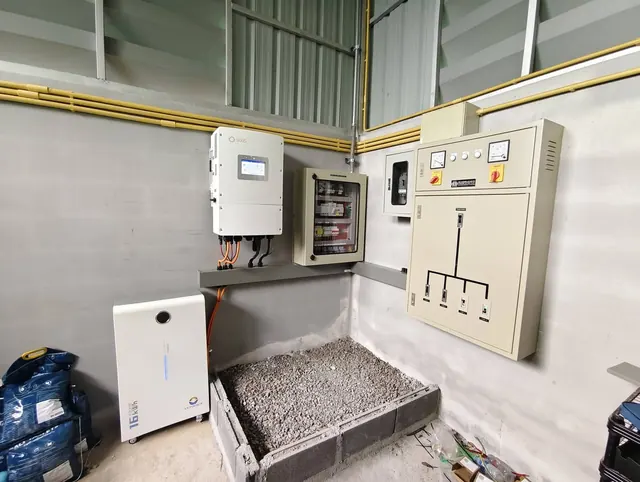
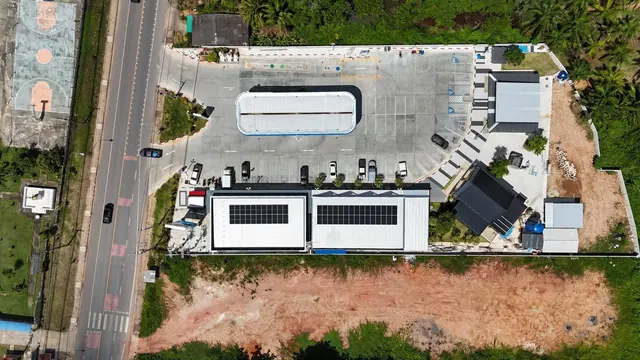
Systems our team has installed and handed over in nearby provinces. Open each one for the site photos and equipment details.
In Krabi and wondering if solar is worth it?
A first estimate from your electricity bill is free — just send a photo of the bill on LINE. We will run the numbers for you first, with figures you can check.
Our team replies in English — on LINE, by email or by phone. Sending a photo of your electricity bill and your location on LINE is the quickest way to get an estimate.
Read before you decide
- Solar Water Pumps for Rubber Plantations and Shrimp Ponds: How to ChoosePumps run during the day, exactly when panels produce power, and their timing is flexible — which makes them one of the most cost-effective uses of solar.
- How Much Can Hotels in Southern Thailand Save With Rooftop Solar?Hotels use power at exactly the time panels produce it, but the design has to allow for low season — otherwise the power you generate flows out for next to nothing.
- Is Solar Worth It for Cold Storage and Ice Plants?Compressors that run all the time are the load that absorbs daytime solar power best — and cold storage is a core industry in Songkhla and Nakhon Si Thammarat.