Solar panel installation in Southern Thailand
Cut the electricity bill for your home, villa, resort or factory with rooftop solar, designed around your actual bill and how you use power. From Phuket and Koh Samui to Hat Yai and Nakhon Si Thammarat, we handle every permit along the way.
Free first estimate from your bill · No survey needed yet · No obligation
Or call our technicians directly on +66 92 296 9191
Our team replies in English — on LINE, by email or by phone. Sending a photo of your electricity bill and your location on LINE is the quickest way to get an estimate.
What rooftop solar can do for you
- Lower electricity bill by
- 30–70%
- Typical homes land around 30–50%; 70% is for homes or shops that use most of their power in the daytime.
- Payback — homes
- 6–10 years
- Payback — shops & factories
- 4–7 years
Estimated at THB 4.20 per kWh and Southern Thailand sunshine levels. Actual figures depend on your bill and when you use electricity.
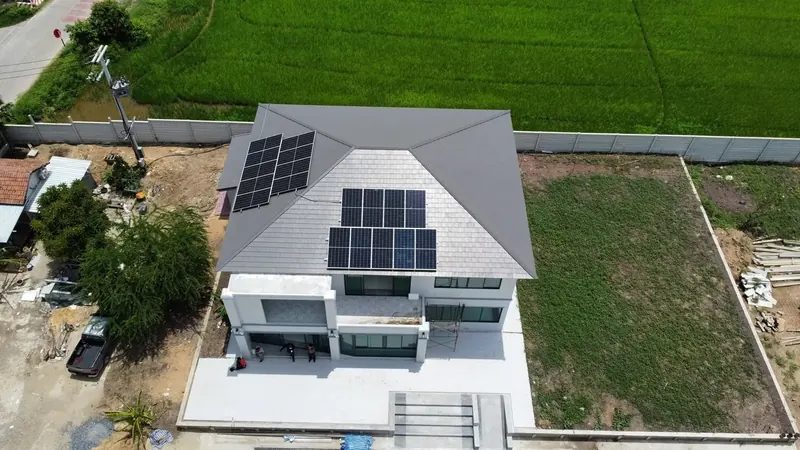
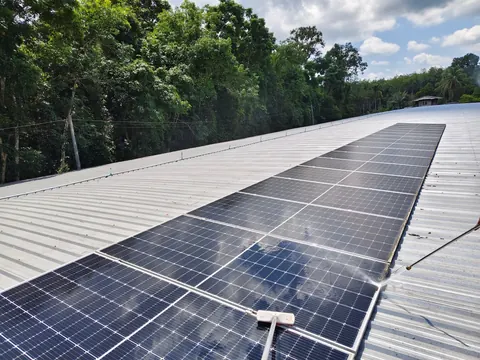
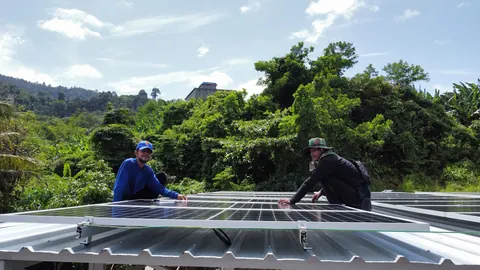
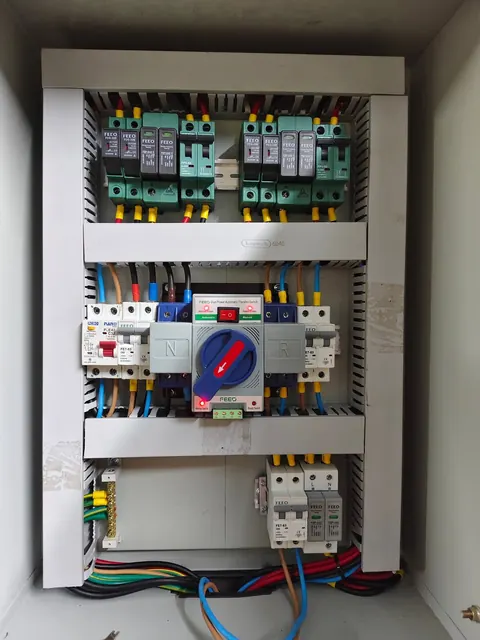
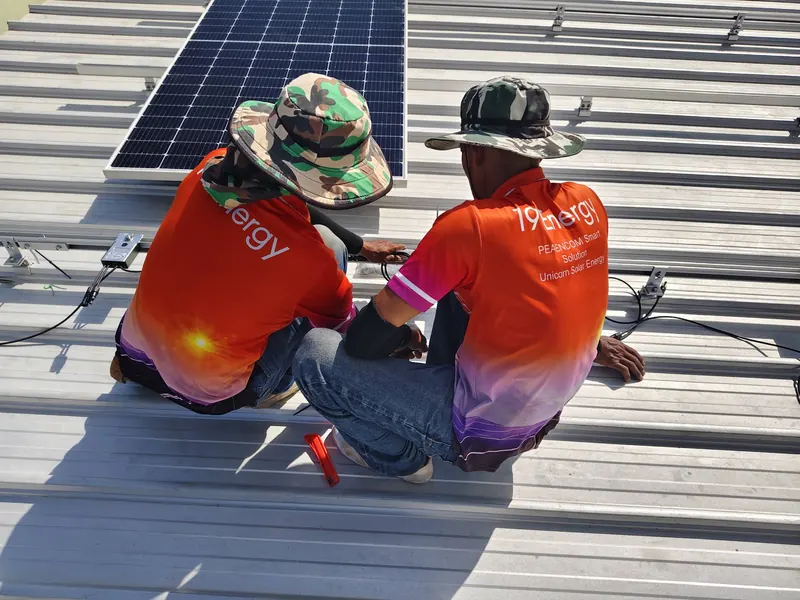
A real job by our own installation team. See 467 more photos
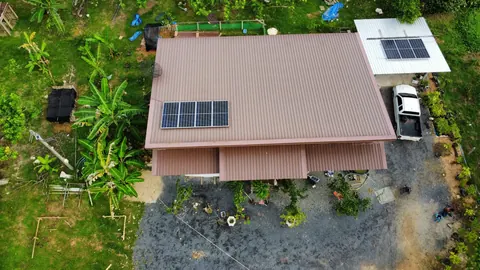
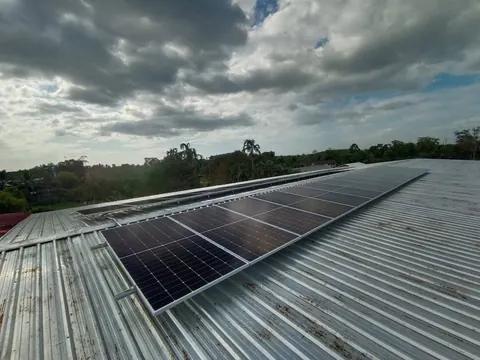
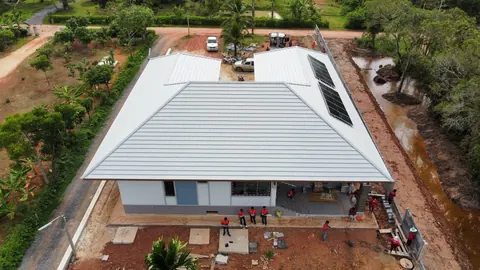
Systems we have installed ourselves
Homes, factories, hotels and farms in Southern Thailand — every photo comes from a site our own team worked on.
2-year installation warranty
19Energy's own technicians handle every job, from installation to aftercare.
All paperwork handled
We file the PEA and ERC applications for you, start to finish.
Serving Southern Thailand
Our office is in Nakhon Si Thammarat, and our team comes out to sites across the South.
2 years of free aftercare
Panel cleaning, a system check and a look at your home's wiring. We contact you in advance before each visit.
VAT-registered, full tax invoices
Full tax invoices, with 3% withholding tax supported for corporate clients.
Equipment you can verify
JA Solar, LONGi or Jinko Solar panels, HUAWEI, Solis or Deye inverters — the exact model is written into your quote.
Planned together
Clear information, so you can decide with confidence
We lay out the system size, the results you can expect, the equipment and the warranty in plain terms, so you can see the whole picture before the project starts.
The right system size
Calculated from your bill and the hours you use power, so the size fits the way you actually live or run your business.
Generation & payback estimate
We explain the electricity rate and the Southern Thailand sunshine data behind the numbers, and answer every question you have.
A clear equipment list
Brand, model, number of panels, inverter and the scope of work — all written into your quote.
Warranty by component
You get the warranty period for the panels, the inverter and the installation work, each spelled out in full.
System sizes
The sizes we install most often
The price depends on your roof and how you use electricity. We survey the site first, then quote a price that holds.
5 kW
Single-phase or three-phase system · 8 panels
Homes where someone is in during the day or the air-con runs in the afternoon. The most cost-effective starting size for a house, and it works on an existing single-phase supply without changing the meter.
- 8 JA Solar, LONGi or Jinko Solar panels
- HUAWEI, Solis or Deye inverter
- Generates around 6,750 kWh a year
- Needs about 23 m² of roof space
- All permit applications handled
- 2-year installation warranty
Best for
Homes with a bill of roughly THB 3,000–5,000 a month
10 kW
Single-phase or three-phase system · 16 panels
Shops, offices, pool villas and large homes that use power steadily through the day. The best return per baht invested. Single-phase homes can take it if the meter allows — we check the meter size first.
- 16 JA Solar, LONGi or Jinko Solar panels
- HUAWEI, Solis or Deye inverter
- Generates around 13,500 kWh a year
- Needs about 45 m² of roof space
- All permit applications handled
- 2-year installation warranty
Best for
Large homes, pool villas, shops and daytime businesses
15 kW
Three-phase system · 24 panels
Businesses that run all day use almost every unit the moment it is generated, so they pay back noticeably faster than homes.
- 24 JA Solar, LONGi or Jinko Solar panels
- HUAWEI, Solis or Deye inverter
- Generates around 20,250 kWh a year
- Needs about 68 m² of roof space
- All permit applications handled
- 2-year installation warranty
Best for
Small factories, hotels and commercial buildings
20 kW
Three-phase system · 32 panels
Continuous loads such as cold rooms, large pumps and production lines — every unit generated gets used.
- 32 JA Solar, LONGi or Jinko Solar panels
- HUAWEI, Solis or Deye inverter
- Generates around 27,000 kWh a year
- Needs about 90 m² of roof space
- All permit applications handled
- 2-year installation warranty
Best for
Factories, cold storage and buildings with heavy all-day loads
Generation is estimated from Southern Thailand sunshine of 1,350kWh per kW of panels per year, rainy season included. Actual output depends on roof direction, tilt and shading. If your usage doesn’t match these sizes, we can design a different size for you.
Who we install for
Designed around how you use electricity
A home and a factory use power in very different ways, so the most cost-effective system is different for each.
Homes & villas
Most homes use the most power from evening into the night, so we size the system to match your real daytime use.
See detailsFactories & commercial buildings
Businesses that run through the day get the best value, because they use almost everything the panels generate the moment it is produced. They pay back faster than homes.
See detailsHotels & resorts
We plan the installation in phases to keep disruption to your guests to a minimum, and we look after the system after handover.
See detailsWarranty
Warranty listed part by part
Solar panels carry two warranties: a product warranty and a power output warranty. The inverter and the installation work each have their own warranty period too.
Each part’s warranty period is listed here, and the original warranty documents come with every installation.
| Component | Period |
|---|---|
Solar panels — product warranty Set by each panel manufacturer for the brand and model you choose, stated in your quote | Per manufacturer |
Solar panels — power output warranty Set by each panel manufacturer for the brand and model you choose, stated in your quote | Per manufacturer |
Inverter Most major brands give 10 years, and it can be extended | 10 years |
Installation and mounting work by 19Energy 19Energy's own technicians handle every job | 2 years |
How it works
From your first call to switching the system on
Step 1: Review your bill
Send us your recent electricity bills so we can see how much power you use and when you use it.
Step 2: On-site survey
We measure the roof, check the structure, the sun direction and where the equipment will go. The survey costs THB 1,200–1,500 and is refunded in full against your quote when you go ahead with the installation.
Step 3: Quote with the calculation
We show you exactly which assumptions the savings and payback figures are based on.
Step 4: Installation & permits
We install the system and handle all the paperwork with the electricity authority until your system is up and running.
Service areas
Solar installation and aftercare across the South
We provide surveys, installation and after-sales care in these areas.
FAQ
What customers ask us most
Is there a charge for the on-site survey?
Yes. The survey costs THB 1,200–1,500 for sites within 100 km, and it is refunded in full against your quote when you go ahead with the installation — so if you choose us, the survey effectively costs nothing. It covers fuel, a technician's full day away from installation work, and the time to measure, calculate and write up your report. A first estimate from your electricity bill is free — just send a photo of the bill on LINE.
How long does solar take to pay for itself in Nakhon Si Thammarat and the South?
A typical home pays back in around 6–10 years. Shops, factories and businesses that use most of their power during the day pay back faster, in around 4–7 years. These figures assume electricity at THB 4.20 per kWh and the actual sunshine levels of Southern Thailand. Payback differs from one property to the next depending on your bill and when you use electricity, so we calculate it for your property before every quote.
It rains a lot in the South. Does solar really produce power here?
Yes. Solar panels run on light, not heat, so they still generate on overcast days — just less than on a bright, sunny day. We calculate with the year-round average sunshine for Southern Thailand, rainy season included. This figure is lower than for Central or Northeastern Thailand, which get stronger sun.
Do I need permission to install solar, and who handles it?
Yes. The system has to be registered with PEA (the Provincial Electricity Authority) to connect to the grid, a license-exemption notice has to be filed with the ERC (Energy Regulatory Commission), and in some cases an engineer has to certify the roof structure. We handle every step, so you don't need to deal with any of the agencies yourself.
What is covered by the warranty, and for how long?
We list the warranty for each component separately: Solar panels — product warranty: Per manufacturer; Solar panels — power output warranty: Per manufacturer; Inverter: 10 years; Installation and mounting work by 19Energy: 2 years. The original warranty documents are handed over with every installation.
Want to know if solar is worth it for your property?
Send us your electricity bill and we’ll work out what size you need, how much you could save and how long it would take to pay back — at no cost.
Read before you decide
- Monthly Bill of THB 3,000, 5,000 or 10,000 — What Size Solar System Do You Need?The best-value size is not the largest your roof can hold — it is the size that matches the electricity you use during the day.
- Is Solar Worth It in Nakhon Si Thammarat? Working It Out From Your Real BillMost people ask how high a bill has to be before solar pays off. Just as important is when you use electricity, because panels only generate during the day.
- 7 Things to Check Before Choosing a Solar Installer in Southern ThailandThe cheapest price is not necessarily the best value, and the most expensive is not necessarily the best. Here is what to look at instead.