Commercial & Factory Solar in Southern Thailand
Businesses that use most of their power in the daytime get the best value from solar — payback of around 4–7 years, significantly faster than a typical home.
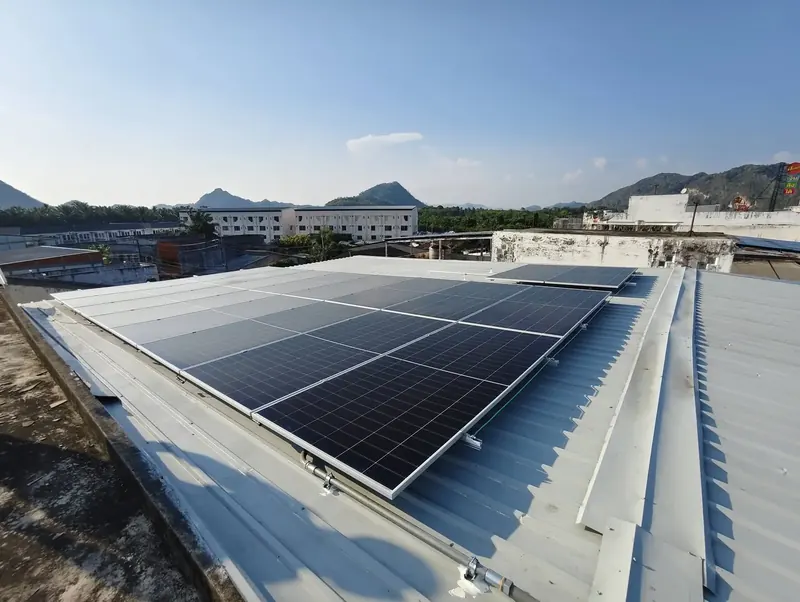
Work on a factory roof — a large system needs the structure and cable routing planned from the start.
The numbers behind it
The value comes from when you use power, not from a discount
Solar panels generate from roughly 8 a.m. to 5 p.m., which overlaps almost exactly with business hours.
When nearly all of that power is used the moment it is generated, every unit is worth the full electricity rate of THB 4.20 per unit — instead of flowing out to the grid at a low buy-back rate the way it does for many homes.
A business can also depreciate the system in its accounts, a benefit homeowners don't get. We recommend discussing this with your company's accountant before you decide.
Side by side
| Item | Home | Business |
|---|---|---|
| Peak usage | Evening–night | Daytime |
| Share of power used on site | ~30–50% | ~75–90% |
| Payback | 6–10 years | 4–7 years |
| Can sell power back | Yes (quota) | No |
Payback is estimated at THB 4.20per kWh and Southern Thailand sunshine. Actual results depend on each business's load and operating hours.
Businesses we install for
Who rooftop solar suits best in Southern Thailand
Manufacturing plants
Machines run at full load through the day and use almost everything the panels generate — the fastest-payback group.
Cold storage and ice plants
Compressors run around the clock, a load that absorbs daytime power very well — and a core industry in Songkhla.
Hotels and resorts
Air-con, lifts, water pumps and kitchens use power all day. Installation can be phased so guests are not affected.
Offices and shophouses
Open during business hours, which line up almost exactly with the hours when the panels produce the most.
Restaurants and cafés
Freezers, ice makers and air-con draw power continuously for as long as you are open.
Farms and agriculture
Water pumps for shrimp ponds and rubber plantations run in the daytime, which suits solar well.
Petrol stations need extra safety design: electrical equipment must stay outside the hazardous areas around the pumps and fuel tanks. Solar for petrol stations
Paperwork
We take care of the most tedious part
Commercial solar doesn't end when the panels go up. Several authorities have to be notified, and installing without the proper permits risks fines and an order to remove the system.
Provincial Electricity Authority (PEA)
Grid-connection application, confirming the equipment is on the approved list, and coordinating the meter change
Energy Regulatory Commission (ERC)
Systems under 1,000 kVA file a license-exemption notice; larger systems need a full license
Structural engineer's certification
Calculates and certifies that the roof can carry the system — a required document for the applications
Building-modification permit
Needed when the installed area or weight exceeds the ministerial-regulation thresholds. We file it with the local authority.
These requirements are revised from time to time. We check the latest criteria with each authority before filing, rather than relying on old documents.
Tax and accounting
The tax questions accounts teams ask before approving
Tax invoices and withholding tax
- 19Energy is a VAT-registered company and issues full tax invoices in your company's name.
- 3% withholding tax works as normal for corporate clients.
- Every quote states whether prices are before or after VAT.
- The system is an asset that can be depreciated under normal accounting rules; ask your accountant for the exact tax effect for your business.
1.5x deduction on equipment cost
Under Royal Decree No. 805 of 2026, which runs until the end of 2028, companies and people with business income can deduct 1.5 times the equipment cost as an expense. Only the equipment counts — installation labor is not included — and these conditions apply:
- The equipment must be new and never used before
- The equipment must carry the No. 5 energy-efficiency label as specified by the authorities
- It cannot be claimed on top of other investment-promotion measures
Confirm with your accountant how this applies to your business before deciding. Read the full 2026 solar tax deduction rules
Process
From assessment to a running system
Step 1: Load analysis
Review past electricity bills and your actual operating hours
Step 2: Roof survey
Measure the area, inspect the structure and lay out the panels
Step 3: Design and quote
System size, expected return and every assumption, in writing
Step 4: Permit applications
Filed with the PEA, the ERC and the local authority
Step 5: Install and hand over
Installation, testing, and handover of the original warranty documents
FAQ
What business owners ask us most often
Can you issue a full tax invoice?
Yes. 19Energy is a VAT-registered company, so we can issue a full tax invoice in your company's name, and 3% withholding tax works as normal for corporate clients. Our quotes state clearly whether prices are before or after VAT.
What tax benefit is there if the company buys the system?
Under Royal Decree No. 805 of 2026, companies and people with business income can deduct 1.5 times the equipment cost as an expense; installation labor is not included. The equipment must be new and carry the No. 5 energy-efficiency label, and the deduction cannot be combined with other investment-promotion measures. The measure runs until the end of 2028. Confirm how it applies to your business with your accountant.
Do factories really pay back faster than homes? Why?
Yes — and the reason is not equipment prices but when you use electricity. Factories and businesses run during the day, exactly when the panels are generating, so they use almost all of the power themselves. Homes, by contrast, use most of their power at night. When you use the power yourself, every unit saves you the full electricity rate, which is why payback is around 4–7 years for businesses compared with 6–10 years for homes.
Can a factory sell power back to the grid?
Generally, no. The rooftop solar buy-back scheme is open only to residential meters. Businesses on commercial or industrial meters have to design the system to use all of the power on site, and must install equipment that prevents power flowing back into the grid, as required by the Provincial Electricity Authority (PEA). We design and install this part for you.
What permits are needed, and how long does it take?
It depends on system size. Systems under 1,000 kVA file a license-exemption notice with the Energy Regulatory Commission (ERC); larger systems need a full power-generation license. There is also the grid-connection application to the PEA, and if the installed area or added weight exceeds the thresholds set by ministerial regulation, a building-modification permit is required as well. The whole process usually takes around 2 to 4 months.
Can the factory roof take the weight?
An engineer has to check it every time. Panels plus mounting weigh around 12 to 15 kg per square meter, which most factory roofs can carry — but we never judge it by eye. We have an engineer calculate and certify the structure in writing, because it is both a safety matter and a document required for the permit applications.
Do we have to stop production during installation?
Most of the work happens on the roof without affecting production. Power only has to be cut temporarily while we connect to the main switchboard and when the PEA comes to change the meter. We schedule these in advance and pick the least disruptive time, such as a holiday or outside working hours.
Estimated at THB 4.20 per kWh and Southern Thailand sunshine (1,350 kWh per kWp per year, rainy season included). Actual payback depends on your bill and when you use electricity — we calculate it for your property before quoting.
Request a quote for your business
Send us your past electricity bills and operating hours, and we will design a system with return figures whose assumptions are laid out for you to check.
Our team replies in English — on LINE, by email or by phone. Sending a photo of your electricity bill and your location on LINE is the quickest way to get an estimate.
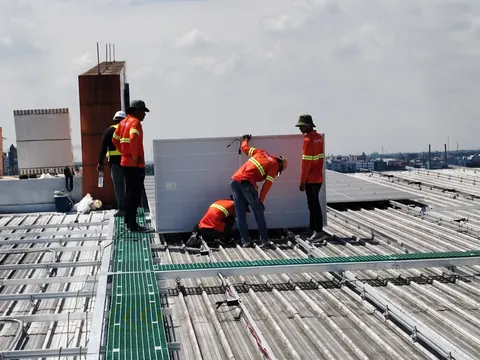
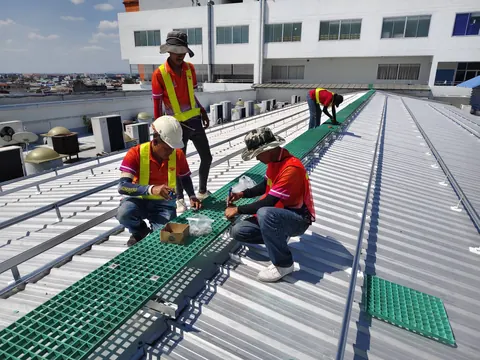
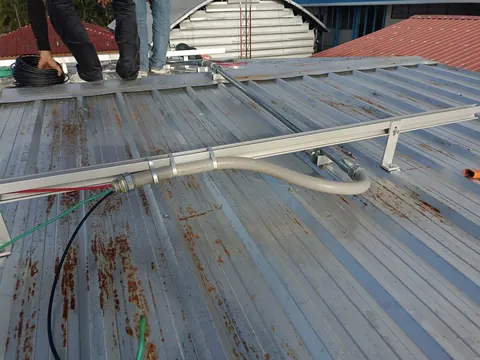
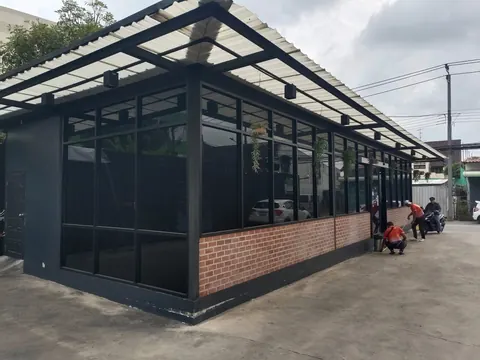
Factory and commercial projects installed by our own team. See all projects
Read before you decide
- Single-Phase vs Three-Phase Power: Do You Need a New Meter for Solar?Your home's power supply sets how big a solar system you can install — and it's worth knowing early whether you need a new meter, which is a separate cost.
- Is Solar Worth It for Cold Storage and Ice Plants?Compressors that run all the time are the load that absorbs daytime solar power best — and cold storage is a core industry in Songkhla and Nakhon Si Thammarat.
- Can You Put Solar on a Shophouse or Commercial Building?A small roof but heavy daytime use — a completely different equation from a detached house, and one that often turns out better than people expect.