Solar for Rice Fields and Rice Mills in Southern Thailand
Rice fields use power for pumping in the growing season, while rice mills use it for motors whenever there is paddy to mill. The two need different designs — and both should be sized from a whole year of use.
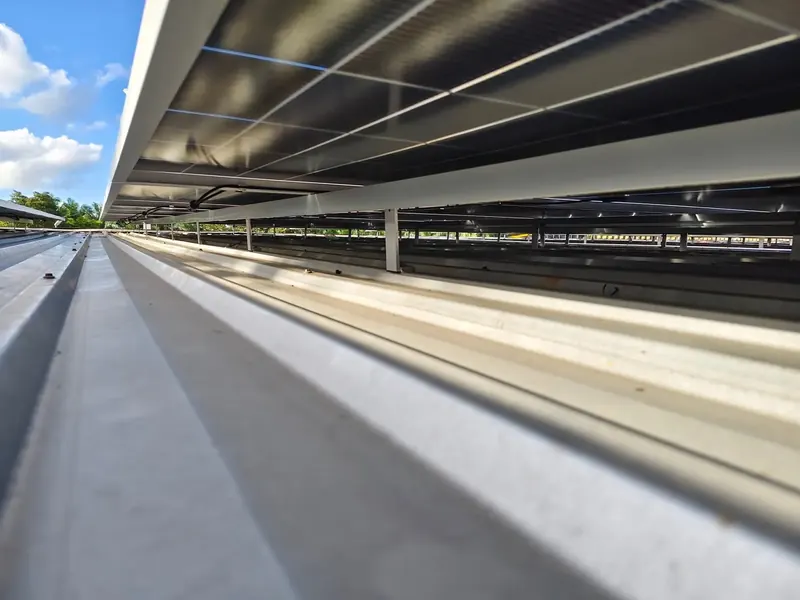
Water pump and agricultural work by our installation team.
Who it suits
Rice-growing areas and mills we serve
Rice farmers who pump water into their paddies, community rice mills and small factories in farming areas. Below are districts where rice fields are a main land use.
- Cha-uat, Nakhon Si ThammaratRice fields, rubber and oil palm, with rice mills and small factories. Many plots have no grid power.
- Khuan Khanun, PhatthalungPhatthalung's large rice-growing area, where paddy pumps are the main load.
- Khao Chaison, PhatthalungRice fields and rubber; the low land by the lake floods in the rainy season.
- Ranot, SongkhlaSongkhla's large rice-growing area between the lake and the Gulf of Thailand, with salt air from both sides.
- Hua Sai, Nakhon Si ThammaratRice fields and aquaculture ponds on the Gulf coast — paddy pumps and aerators use power in very different ways.
- Chian Yai, Nakhon Si ThammaratPak Phanang river basin: seasonal paddy pumping, soft ground and a shallow water table.
- Chaiya, Surat ThaniRice fields and coconut groves, with coconut fronds shading house roofs.
For other locations, see all service areas.
Power use versus sunshine
Where the power goes in rice fields and mills
Loads that run in the daytime, or can be moved into sunny hours, are where solar pays off best. Overnight loads need a different design.
Paddy pumps
They run in the rice-growing season and can be moved entirely into the sunniest hours, so almost none of the solar power goes to waste — but they barely run outside the season.
Pond aerators
Where rice fields sit alongside fish or shrimp ponds, aerators have to run through the night. A system that only produces power in sunlight can't cover this; it needs a battery or the grid kept as backup.
Rice-mill motors
Hullers, whitening machines and conveyors run whenever there is paddy to mill. If the mill works mainly in the daytime, almost all the solar power is used as it is produced.
Small-factory machinery
Factories that run during daytime working hours use a high share of their own solar power and pay back faster than homes.
The house and rice store
These loads exist all year. On the same meter as the pump or mill, they soak up solar power when no water is being pumped and no rice is being milled.
Night-time lighting
An on-grid system can't help with night loads. Lights where the grid doesn't reach need a small, separate battery set.
Businesses that use most of their power in the daytime typically pay back in around 4–7 years. Estimated at THB 4.20 per kWh and Southern Thailand sunshine (1,350 kWh per kWp per year, rainy season included). Actual payback depends on your bill and when you use electricity — we calculate it for your property before quoting. Seasonal paddy pumping and mills with irregular hours will differ from this.
Rice mills and small factories
Solar for rice mills, sized to real milling hours
A rice mill uses power when there is paddy to mill, not evenly every day like an office. If most milling happens in the daytime, almost all the solar power is used as it is produced.
If the mill runs hard for part of the year and almost stops for the rest, sizing from the highest monthly bill gives a system that is bigger than it needs to be.
We ask for a full year of bills and the mill's real operating hours before proposing a system size.
What we check at a rice mill
- A full year of bills and the hours the mill runs each day
- Meter type and number of phases, against the system size you want
- The mill roof structure, checked by an engineer for load
- Where dust is exhausted, so panels can be laid out away from it
- When power has to be cut for connection — on a day with no milling
If the mill has a metal sheet roof, see how panels are fixed without leaks on solar on metal sheet roofs.
Design points for farmland
What decides whether a paddy or mill system lasts
Paddies far from the house, with no grid power
A solar pump set placed where the water is pumped usually costs less than running power lines to the plot — no new meter, and no grid-connection application.
Ground frames on soft soil
In low-lying areas with a shallow water table, a concrete base on soft ground can sink and tilt. The base has to spread the load or use short piles — a cost we state in the quote from the start.
Equipment above flood level
Low land near the lake floods in the rainy season. Control boxes and inverters must be mounted above the highest flood level at that site, which we ask the owner about every time.
Salt air in coastal paddies
Fields near the coast, or between the lake and the sea, need corrosion-resistant mounting hardware and connectors chosen at the design stage.
Husk and bran dust at the mill
Dust blown from a mill's exhaust points can settle on nearby panels. The panel layout should keep away from them, and cleaning should be planned more often than usual.
Meter size and motor starting current
A PEA (Provincial Electricity Authority) single-phase meter tops out at around 10 kW in practice, and motors draw more current when starting than when running. If motors are to run from batteries, the inverter must handle that starting current too.
System sizes
Standard sizes for farm homes, rice mills and small factories
Solar pump sets in the field are designed around water volume and delivery distance. Grid-connected systems can use one of the sizes below, or a different size designed around your real usage.
5 kW
Single-phase or three-phase · 8 panels
Homes with a bill of roughly THB 3,000–5,000 a month
- Output per year
- ~6,750 kWh
- Roof area
- ~23 m²
10 kW
Single-phase or three-phase · 16 panels
Large homes, pool villas, shops and daytime businesses
- Output per year
- ~13,500 kWh
- Roof area
- ~45 m²
15 kW
Three-phase · 24 panels
Small factories, hotels and commercial buildings
- Output per year
- ~20,250 kWh
- Roof area
- ~68 m²
20 kW
Three-phase · 32 panels
Factories, cold storage and buildings with heavy all-day loads
- Output per year
- ~27,000 kWh
- Roof area
- ~90 m²
Output estimated from Southern Thailand sunshine of 1,350 kWh per kWp per year, rainy season included. Real output depends on direction, tilt and shading at your site.
Equipment we use
- Solar panels
- JA Solar, LONGi or Jinko Solar · N-type TOPCon, dual-glass, 620–630 W per panel
- Inverters
- HUAWEI, Solis or Deye · On-grid and hybrid inverters with a monitoring app so you can check your generation history yourself
- Batteries (when you need power at night)
- LVTopsun or Sunwoda · LiFePO4 lithium batteries for hybrid systems, sized to your night-time consumption
The exact brand and model are written into your quote before you sign anything.
Warranty, component by component
- Solar panels — product warrantySet by each panel manufacturer for the brand and model you choose, stated in your quotePer manufacturer
- Solar panels — power output warrantySet by each panel manufacturer for the brand and model you choose, stated in your quotePer manufacturer
- InverterMost major brands give 10 years, and it can be extended10 years
- Installation and mounting work by 19Energy19Energy's own technicians handle every job2 years
2 years of free aftercare: Panel cleaning once a year · Annual system health check · A check of your building's wiring while we are there. See warranty terms
How to start
An estimate from your bills first, then a site survey
Send your electricity bills and the field or mill location
A first estimate from your bills is free. For a plot without power, tell us the water source and rough delivery distance.
Book an on-site survey
Site surveys are by appointment, and any travel charge is confirmed before booking. The survey costs THB 1,200–1,500 and is refunded in full against your quote when you go ahead with the installation.
We measure what decides the system size
Water level and delivery distance, soil conditions for the frame base, past flood levels, the meter and the mill roof structure.
A quote with its assumptions
System size, equipment brand and model, and return figures with every assumption open to check.
FAQ
What rice farmers and mill owners ask us most
Our paddy is far from the house with no electricity. Can we use a solar pump?
Yes, and it is often better value than bringing power lines in. A solar pump set at the pumping point needs no new meter and no grid-connection application, because it isn't connected to the utility supply. We size it from the volume of water to pump, the water level at the source and the real delivery distance.
We only pump water into the paddy during the growing season. Is it worth it?
If it's combined with the house supply and sized for the growing season, the extra power goes to waste in the months without pumping. In that case a separate solar pump set is usually better value. If a home or business on the same meter uses daytime power, a combined system lets that load use the surplus, so nothing goes to waste. We compare both options in numbers first.
Our small rice mill is on a single-phase meter. How big a system can it take?
A PEA single-phase meter takes around 10 kW in practice. If the mill's usage calls for a bigger system, it first needs three-phase supply — a separate cost paid to PEA. We check the meter size and motor loads during the survey and tell you what size makes sense.
Can a rice mill sell surplus solar power back to the grid?
Generally not. The rooftop buy-back scheme accepts only residential meters. Rice mills and factories on a commercial meter must be designed to use all their own power, with a device that prevents power flowing back into the grid. We design and install this part.
Will dust from the mill reduce output?
It can if dust builds up thickly and isn't cleaned. Rain washes off some ordinary dust, but caked-on dust has to be cleaned off. So we lay out the panels away from dust exhausts, leave access for cleaning, and during the aftercare period we clean the panels once a year. Very dusty sites should be cleaned more often.
Our fields have fish or shrimp ponds and the aerators run all night. Can you help?
Yes, but it needs a battery system, or the grid kept connected as backup. A system that only produces power in sunlight has nothing for the aerators at night, which puts the pond stock at risk. We design the daytime pumping part and the overnight part separately and clearly.
What does a site survey cost, and can you issue tax invoices to a mill?
A first estimate from your electricity bill is free — just send a photo of the bill on LINE. An on-site survey costs THB 1,200–1,500, refunded in full against your quote when you go ahead with the installation. Site surveys are by appointment, and any travel charge is confirmed before booking. We are VAT-registered, issue full tax invoices and support 3% withholding tax for corporate clients.
Related work
Other farm and business work we install for
Tell us how many months you pump, or when the mill runs
Those two things decide the system size more than the field area or the size of the mill. Send us your bills for a free first estimate.
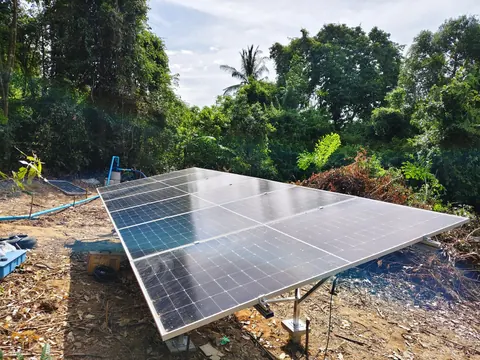
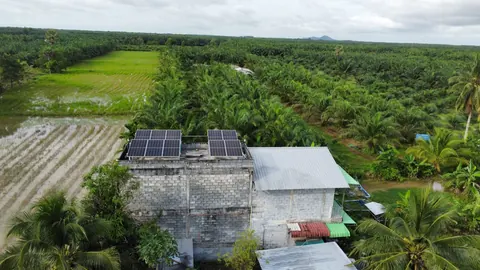
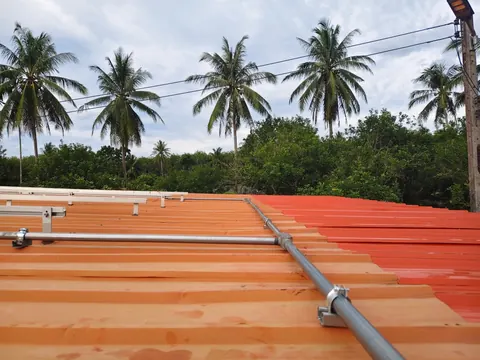
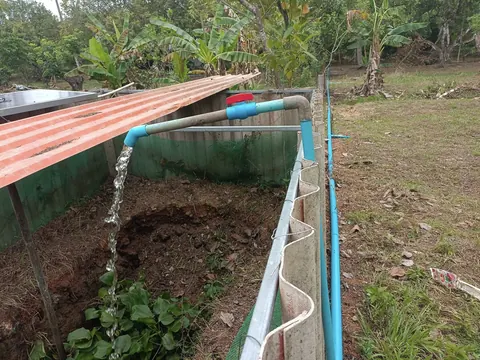
Water pump and agricultural work by our installation team. See all projects
Read before you decide
- Solar Water Pumps for Rubber Plantations and Shrimp Ponds: How to ChoosePumps run during the day, exactly when panels produce power, and their timing is flexible — which makes them one of the most cost-effective uses of solar.
- Single-Phase vs Three-Phase Power: Do You Need a New Meter for Solar?Your home's power supply sets how big a solar system you can install — and it's worth knowing early whether you need a new meter, which is a separate cost.
- Can Lightning Strike Solar Panels? The Protection You Need in Southern ThailandRooftop panels don't attract lightning the way many people fear, but surge damage from a nearby strike is real — and it can be prevented.