Solar for Fruit Orchards and Packing Houses in Southern Thailand
Fruit orchards use power for irrigation mainly in the dry season, and packing houses use it heavily only in the harvest season. A system that pays off has to be designed from the whole year's usage, not from the month with the highest bill.
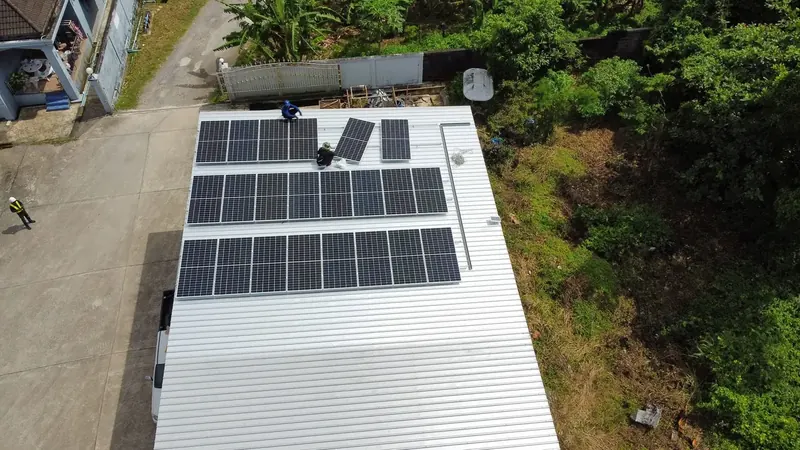
Water pump and agricultural work by our installation team.
Who it suits
Fruit orchards and packing houses in the areas we serve
Mangosteen, rambutan, longkong, coconut and other fruit orchards in Southern Thailand, plus fruit packing and sorting houses. Below are districts where fruit growing is a mainstay of the local economy.
- Lang Suan, ChumphonFruit packing houses, cold rooms and durian orchards with heavy power use only in the harvest season.
- Ban Na San, Surat ThaniHome of the Rong Rian rambutan — hillside fruit orchards, packing houses and buying yards.
- Lan Saka, Nakhon Si ThammaratMangosteen, durian and longkong orchards at the foot of Khao Luang, humid for most of the year.
- Tamot, PhatthalungRubber and fruit orchards on sloping land at the foot of the Banthat range.
- Pa Phayom, PhatthalungRubber and fruit orchards close to the Banthat range, where the ridge cuts off morning or evening sun.
- Chaiya, Surat ThaniTall coconut groves around the house, with palm fronds casting moving strips of shade on the roof.
- Sichon, Nakhon Si ThammaratRubber and fruit orchards where water pumps are the main load.
- Na Thawi, SongkhlaRubber and fruit orchards; many family businesses still run on a single-phase meter.
- Chana, SongkhlaRubber and fruit orchards inland, using power mainly for water pumps.
- Sawi, ChumphonOil palm and fruit orchards in one of Chumphon's coastal districts.
For durian orchards specifically, see solar for durian orchards. For other locations, see all service areas.
Power use versus sunshine
Where an orchard's and packing house's power goes
Panels only produce power in daylight. Loads that can be shifted into sunny hours pay off best; night-time loads need a different design.
Orchard irrigation pumps
They run hard in the dry season and almost stop in the rainy season. Irrigation can be moved entirely into the sunniest hours, so nearly all the solar power gets used — but only for half the year.
Pumping water uphill
Hillside orchards have to lift water to higher ground, which takes far more power than pumping on the flat at the same flow rate. It must be calculated from the real height plus pipe length.
Packing-house cold rooms
Compressors run day and night through the harvest season. The daytime part suits solar well; at night the cold rooms still draw from the grid.
Sorting lines and packing machinery
They run during packing-house working hours, mostly in the daytime, so solar power is used the moment it is produced — but only during the harvest season.
The house and storage sheds
These loads exist all year. If they share a meter with the packing house or pump, they soak up the solar power in months without irrigation and outside the season.
Security lights and cameras
These are night-time loads. A system that only produces power in sunlight can't help here — this part needs a small, separate battery-backed set.
Businesses that use most of their power in the daytime typically pay back in around 4–7 years. Estimated at THB 4.20 per kWh and Southern Thailand sunshine (1,350 kWh per kWp per year, rainy season included). Actual payback depends on your bill and when you use electricity — we calculate it for your property before quoting. Orchards and packing houses with seasonal use will differ from this — we calculate every site individually before quoting.
Packing and sorting houses
Solar for fruit packing houses: plan for in-season and off-season
During harvest, packing houses run cold rooms and sorting lines at full capacity, then use far less power once the season ends. The highest monthly bill doesn't represent the whole year.
If a home, office or other business shares the same meter, the power produced out of season still has somewhere to go and the system pays off much better. If not, a smaller system usually gives a better return per baht.
We ask for a full year of past bills before proposing a system size, every time.
What we check at a packing house
- A full year of bills, to see both in-season and off-season months
- Meter type and number of phases, and whether they support the system size you want
- Whether the packing-house roof can carry the system, and what type of roof it is
- When power has to be cut for connection — scheduled outside the harvest season
Design points for orchards
What makes an orchard system pay off — or not
Size from a full year of bills, not the peak month
Packing houses use heavy power only in the harvest season and much less outside it. Sizing to the highest month gives a system that is too big for the rest of the year.
Separate the pump set from the house system when it makes sense
For orchards that irrigate only half the year, a separate solar pump set is usually better value — you don't carry a large system all year. Plots without grid power need no new meter and no grid-connection application.
Shade from fruit trees and coconut fronds
Orchard trees grow taller every year, and coconut fronds cast narrow strips of shade that move all day. Panels wired in series lose more output than the shaded area suggests, so string layout matters — or panels go on a ground frame in the open.
Hillside humidity
Orchards at the foot of the mountains are humid almost all year, so moss and grime build up on panel edges quickly. Panels need enough tilt for water to run off, and room for someone to get up and clean them.
Access to the orchard
Many orchards are reached by dirt tracks or narrow roads that large trucks can't use. We check the route during the site survey and include handling costs in the quote.
Packing-house meter size
A PEA (Provincial Electricity Authority) single-phase meter tops out at around 10 kW in practice. A packing house wanting a bigger system needs three-phase supply — a separate PEA cost worth knowing at the planning stage.
System sizes
Standard sizes for orchard homes, packing and sorting houses
Separate solar pump sets are designed around lift height and water volume. Grid-connected systems can use one of the sizes below, or a different size designed around your real usage.
5 kW
Single-phase or three-phase · 8 panels
Homes with a bill of roughly THB 3,000–5,000 a month
- Output per year
- ~6,750 kWh
- Roof area
- ~23 m²
10 kW
Single-phase or three-phase · 16 panels
Large homes, pool villas, shops and daytime businesses
- Output per year
- ~13,500 kWh
- Roof area
- ~45 m²
15 kW
Three-phase · 24 panels
Small factories, hotels and commercial buildings
- Output per year
- ~20,250 kWh
- Roof area
- ~68 m²
20 kW
Three-phase · 32 panels
Factories, cold storage and buildings with heavy all-day loads
- Output per year
- ~27,000 kWh
- Roof area
- ~90 m²
Output estimated from Southern Thailand sunshine of 1,350 kWh per kWp per year, rainy season included. Real output depends on direction, tilt and shading at your site.
Equipment we use
- Solar panels
- JA Solar, LONGi or Jinko Solar · N-type TOPCon, dual-glass, 620–630 W per panel
- Inverters
- HUAWEI, Solis or Deye · On-grid and hybrid inverters with a monitoring app so you can check your generation history yourself
- Batteries (when you need power at night)
- LVTopsun or Sunwoda · LiFePO4 lithium batteries for hybrid systems, sized to your night-time consumption
The exact brand and model are written into your quote before you sign anything.
Warranty, component by component
- Solar panels — product warrantySet by each panel manufacturer for the brand and model you choose, stated in your quotePer manufacturer
- Solar panels — power output warrantySet by each panel manufacturer for the brand and model you choose, stated in your quotePer manufacturer
- InverterMost major brands give 10 years, and it can be extended10 years
- Installation and mounting work by 19Energy19Energy's own technicians handle every job2 years
2 years of free aftercare: Panel cleaning once a year · Annual system health check · A check of your building's wiring while we are there. See warranty terms
How to start
An estimate from your bills first, then a site survey
Send your past electricity bills and the orchard location
A first estimate from your bills is free. For a packing house, please include bills from both in-season and off-season months.
Book an on-site survey
Site surveys are by appointment, and any travel charge is confirmed before booking. The survey costs THB 1,200–1,500 and is refunded in full against your quote when you go ahead with the installation.
We measure what decides the system size
Lift height, pipe runs, tree shade, the packing-house roof structure and the access route.
A quote with its assumptions
System size, equipment brand and model, and return figures with every assumption open to check.
FAQ
What orchard and packing-house owners ask us most
Our packing house only runs heavy loads in the harvest season. Is solar worth it?
It depends on what else uses power outside the season. If the packing house shares a meter with a home or another business that uses daytime power all year, none of the solar output is wasted. If almost nothing runs outside the season, the system is less worthwhile than for a business with steady use. We calculate from a full year of bills first, and if the numbers say a smaller system makes more sense, we'll recommend the smaller one.
Our cold rooms run all night. How much can solar help?
Only during daylight hours. At night the cold rooms keep drawing from the grid as before. An on-grid system cuts the daytime part of the bill, which is when compressors work hardest because of the heat. Covering the night as well means adding batteries, which raises the investment considerably. We compare both options in numbers before you decide.
Are mangosteen, rambutan and longkong orchards different from durian?
The design principle is the same: the main load is irrigation, used heavily in the dry season. What differs is the height the water must be lifted, the pipe length and the number of outlets in each orchard, which we measure on site. For durian orchards specifically, see our durian orchard page.
The orchard is far from the house and has no grid power. Can you do it?
Yes. A solar pump set placed where the water is used needs no new meter and no grid-connection application, because it isn't connected to the utility supply. It usually costs less than running power lines to a plot far from the distribution line.
Can a packing house sell surplus solar power back to the grid?
Generally not. The rooftop buy-back scheme accepts only residential meters. Businesses on a commercial meter must be designed to use all their own power, with a device that prevents power flowing back into the grid. We design and install this part.
Can you issue a tax invoice in the name of our company?
Yes. We are VAT-registered, issue full tax invoices and support 3% withholding tax for corporate clients. The quote states clearly whether prices include VAT.
Is there a fee for the site survey?
A first estimate from your electricity bill is free — just send a photo of the bill on LINE. An on-site survey costs THB 1,200–1,500, refunded in full against your quote when you go ahead with the installation. Site surveys are by appointment, and any travel charge is confirmed before booking.
Other farm work
Other crops and farm businesses we install for
Send us a full year of bills for your orchard or packing house
We give you a free first estimate from the bills, including whether a separate pump set or one combined system makes more sense — before you decide on a site survey.
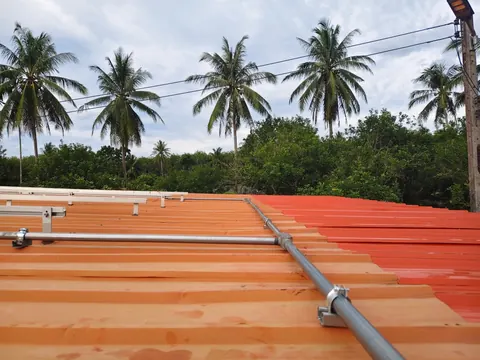
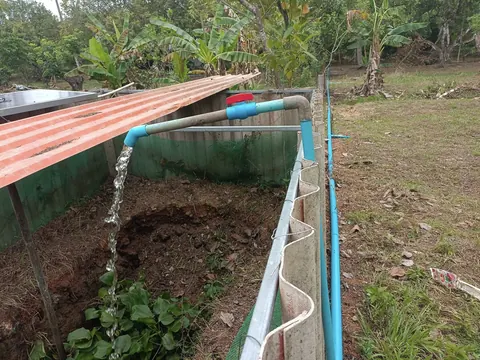
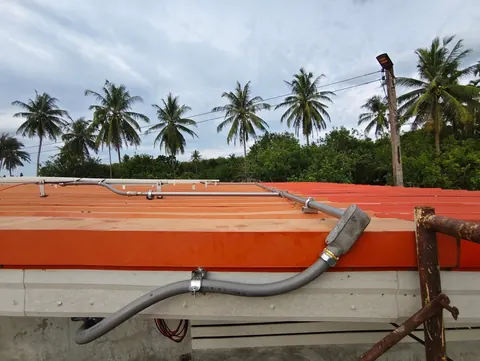
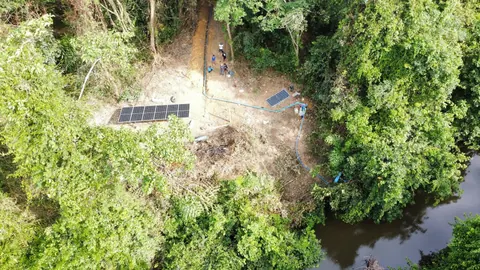
Water pump and agricultural work by our installation team. See all projects
Read before you decide
- Solar Water Pumps for Rubber Plantations and Shrimp Ponds: How to ChoosePumps run during the day, exactly when panels produce power, and their timing is flexible — which makes them one of the most cost-effective uses of solar.
- Is Solar Worth It for Cold Storage and Ice Plants?Compressors that run all the time are the load that absorbs daytime solar power best — and cold storage is a core industry in Songkhla and Nakhon Si Thammarat.
- Monthly Bill of THB 3,000, 5,000 or 10,000 — What Size Solar System Do You Need?The best-value size is not the largest your roof can hold — it is the size that matches the electricity you use during the day.