Solar Panels for Expats in Southern Thailand
For foreigners who own or lease a house, villa, resort or business in Phuket, Koh Samui, Koh Pha Ngan, Krabi, Khao Lak or Hat Yai — how rooftop solar works with us, from the first bill photo to PEA switch-on.
The short answer
Yes, you can install solar — the paperwork is what needs care
Southern Thailand is entirely under the Provincial Electricity Authority (PEA). Connecting a solar system to the grid means an engineer-certified design, a notification to the Energy Regulatory Commission (ERC) and a PEA grid-connection application with an on-site inspection.
We handle all of that. For most expat owners the practical questions are different: whose name the meter is in, whether a landlord has to sign, how parts get to an island, and how the equipment copes with sea air. Here are the answers.
We do not give advice on property ownership law. If your ownership structure is unusual, check it with your lawyer; we check the electricity side during the survey.
Step by step
How the process works with 19Energy
The first estimate is free. The site survey is paid, and the fee comes off your quote if you go ahead.
Step 1: Send your bill on LINE or by email
A photo of a recent electricity bill and your location is enough to start. A first estimate from your electricity bill is free — just send a photo of the bill on LINE. Our team replies in English — on LINE, by email or by phone. Sending a photo of your electricity bill and your location on LINE is the quickest way to get an estimate.
Step 2: First estimate — free
From the bill we work out a suitable system size and whether solar is worth it for how you use the property. No survey and no commitment at this stage.
Step 3: Site survey — paid
A technician visits to measure the roof, check the structure, look at the meter and the main switchboard, and note shading. The survey fee is THB 1,200–1,500, refunded in full against your quote when you go ahead with the installation. It covers fuel, a technician's full day away from installation work, and the time to measure, calculate and write up your report.
Step 4: Quote with named equipment
You receive a quote listing the brand and model of every main component, the calculation behind the savings estimate, and whether prices are before or after VAT.
Step 5: Permits and PEA paperwork
We prepare the drawings, arrange a licensed engineer's sign-off, notify the Energy Regulatory Commission (ERC) and apply to the Provincial Electricity Authority (PEA) for grid connection. You provide a small set of documents; we do the rest.
Step 6: Installation, inspection and switch-on
Our own team installs the system. The PEA inspects the site, replaces the meter and approves the connection, and then the system starts running. We book the appointment and our technician is on site for the inspection.
Ownership and permission
Meter holder, landlord or juristic person
These are the questions that decide how the paperwork is done.
Whose name is the meter in?
The PEA application is made for the electricity account holder. The documents need to match that name; if they do not, the meter holder signs a letter of consent. A company that holds the meter applies with its company certificate.
Leased house or villa
The application needs building ownership documents, such as the title deed or sale contract, which the owner provides — along with written consent if the meter is in their name. Agree the installation with your landlord first.
Condominium
The roof belongs to the building's juristic person, so its approval is needed before anything is installed. Individual unit owners cannot decide this alone.
Documents usually needed for the PEA
- A copy of the meter holder's identity document
- A copy of the house registration for the installation address
- A recent electricity bill showing the customer account number
- Building ownership documents, e.g. the title deed or sale contract
- Company registration certificate (only if the applicant is a company)
- A power of attorney, so we can file on your behalf
Some of these may look different for a foreign meter holder or a leased property — for example which ID is accepted, or who holds the house registration. We check what applies to your property during the survey, before anything is filed.
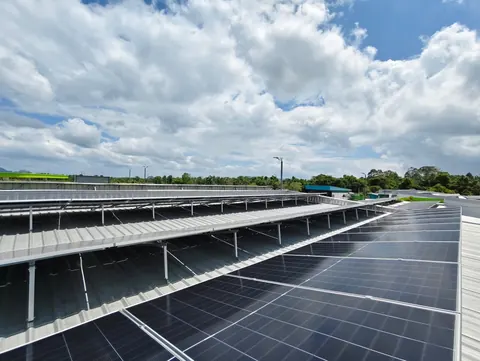
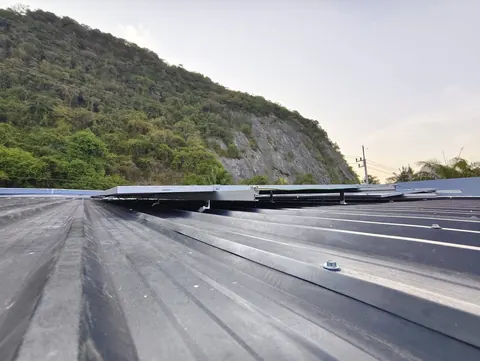
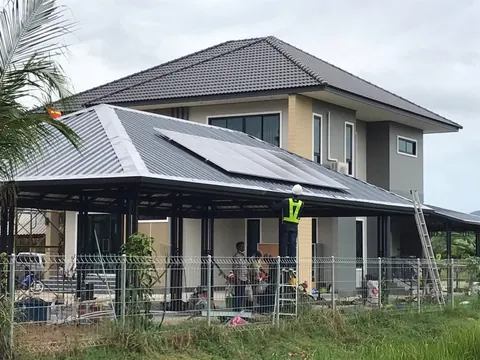
Rooftop systems installed by our own team See all projects
Islands and the coast
What is different about island and beachfront sites
Island logistics
On Koh Samui and Koh Pha Ngan every part crosses by ferry. A change on site that needs more parts can take weeks rather than days, so we survey island jobs in more detail before ordering. As everywhere we serve, any travel charge is confirmed before the survey is booked.
Salt air
Near the sea we use aluminum rails and stainless-steel fixings, keep the inverter out of direct sea spray, and recommend more frequent fresh-water cleaning. Solar near the sea: salt and corrosion
Power cuts and batteries
A standard system switches off in a power cut. If outages are a problem where you are, a hybrid system with a battery keeps chosen circuits running. Buy it for backup, not for payback — a battery always makes payback longer. Hybrid systems and batteries
Payment and warranty
Paying in THB, with a proper tax invoice
All prices and payments are in Thai baht (THB). VAT-registered company — full tax invoices issued, 3% withholding tax supported for corporate clients. Your quote states whether each price is before or after VAT.
Homes typically pay back in 6–10 years and businesses such as resorts in 4–7 years.
Estimated at THB 4.20 per kWh and Southern Thailand sunshine (1,350 kWh per kWp per year, rainy season included). Actual payback depends on your bill and when you use electricity — we calculate it for your property before quoting.
Warranty by component
Solar panels — product warranty
Set by each panel manufacturer for the brand and model you choose, stated in your quote
Solar panels — power output warranty
Set by each panel manufacturer for the brand and model you choose, stated in your quote
Inverter
Most major brands give 10 years, and it can be extended
Installation and mounting work by 19Energy — 2 years
19Energy's own technicians handle every job
Actual terms follow the manufacturer's warranty documents for the model installed, which are handed over with the job.
Tax deduction
Can foreigners claim Thailand's solar tax deduction?
Royal Decree No. 805 of 2026 lets individuals deduct the actual cost of a rooftop system, up to THB 200,000, from Thai personal income tax, for expenses between 3 March 2026 and 31 December 2028.
It only helps if you pay Thai income tax
The deduction is taken off your taxable income; it is not money paid back. If you do not pay Thai personal income tax, there is nothing to deduct it from. If you do, the saving is THB 200,000 multiplied by your tax rate — THB 20,000 at 10%, THB 60,000 at 30%. It does not apply to systems paid for before 3 March 2026.
None of the conditions in our summary of the decree (below) mentions nationality; they are about the tax, the system and the documents. Whether your own situation qualifies is a question for your accountant or the local Revenue Department office.
Conditions for individuals
- Total panel capacity of no more than 10 kW
- A grid-connected system whose connection to the electricity authority has been completed — you claim in the tax year the connection is completed, not the year you paid
- The same name on everything: the taxpayer, the meter holder, the grid-connection applicant and the tax invoice
- Your own home — a rented home does not qualify — and one system per person
- An electronic tax invoice (e-Tax Invoice) issued through the Revenue Department's system; paper tax invoices are not accepted
For expat owners the names are usually the deciding point: if the meter, the grid application or the invoice is in someone else's name or a company's name, the individual deduction does not fit. Because the e-Tax Invoice is required, ask us before you sign what tax invoice we can issue for your job, and have it stated on the quote.
If the system is bought by a company or a business, a different rule applies: 1.5 times the equipment cost can be deducted as an expense (equipment only, not installation labor). The equipment must be new and carry the No. 5 energy-efficiency label, and the deduction cannot be combined with other investment-promotion measures. Read the full summary of the 2026 solar tax deduction
Where we work
Areas popular with expat owners
We provide surveys, installation and after-sales care across the South. Our registered office is in Nakhon Si Thammarat.
FAQ
Questions expat owners ask us
Can foreigners install solar panels in Thailand?
Yes, a foreigner can have a solar system installed on a property they live in or run. What matters for the grid connection is not nationality but the paperwork: the application is made in the name of the person or company that holds the electricity account (the meter), and it needs documents for the building. Which identity documents the local PEA office accepts for a foreign meter holder is something we check during the survey, before any paperwork is filed.
Whose name does the PEA application go in?
The electricity account holder — the name on the meter. The names on the documents must match the meter holder. If they do not match, a letter of consent from the meter holder is needed as well. This often comes up when the meter is still in a previous owner's or a landlord's name, and we can help arrange it.
I rent or lease the property. Can I still install solar?
Often yes, but you need the owner on board. The grid application needs building ownership documents such as the title deed or sale contract, and if the meter is in the owner's name, their written consent. Talk to your landlord before the survey so they are ready to sign. We confirm exactly what is needed for your property during the survey.
Can I put solar on my condo?
The roof of a condominium building is common property that belongs to the juristic person, not to individual unit owners, so an installation needs the juristic person's approval first. If you are on the committee or have approval in hand, contact us and we will look at the building.
Do you work on Koh Samui, Koh Pha Ngan and other islands?
Yes. On islands every part has to cross by ferry, so a fix that needs extra parts can take weeks instead of days. That is why we survey island sites in more detail than usual before ordering anything. As everywhere we serve, any travel charge is confirmed before the survey is booked.
My villa is right by the sea. Will salt air damage the system?
Solar works near the sea, but the materials must be chosen for it from the design stage. We use aluminum mounting rails and stainless-steel fixings on coastal sites, and place the inverter indoors or out of direct sea spray. Panels near the sea should also be rinsed with fresh water more often, because dried salt blocks light and rain does not wash it off completely.
Should I add a battery because of power cuts?
Only if power cuts are a real problem for you. A standard grid-tied system shuts down during a power cut for safety reasons; to keep power on you need a hybrid system with a battery. A battery always makes payback longer, so it is worth it for backup, not for saving money faster.
How do I pay, and can I get a tax invoice?
Payment is in Thai baht (THB). VAT-registered company — full tax invoices issued, 3% withholding tax supported for corporate clients. Your quote states clearly whether prices include VAT.
Can foreigners claim Thailand's solar tax deduction?
The deduction (Royal Decree No. 805 of 2026) is taken against Thai personal income tax: the actual cost of a rooftop system, up to THB 200,000, for expenses from 3 March 2026 to 31 December 2028. None of the conditions in our summary of the decree mentions nationality; they are about the tax, the system and the paperwork: you must pay Thai personal income tax, the system must be no more than 10 kW, grid-connected and approved, on your own home (a rented home does not qualify, and it is one system per person), the names of the taxpayer, meter holder, grid applicant and tax invoice must all be the same person, and the invoice must be an electronic tax invoice (e-Tax Invoice) — paper tax invoices are not accepted. Ask us before you sign what tax invoice we can issue for your job and have it stated on the quote. Whether your own situation qualifies is a question for your accountant or the local Revenue Department office.
If I don't pay Thai income tax, does the solar deduction help me?
No. THB 200,000 is an amount taken off taxable income, not money paid back, so if you have no Thai personal income tax to pay there is nothing to deduct from. The actual saving is THB 200,000 multiplied by your tax rate — for example THB 20,000 at a 10% rate.
How long does it take before the system runs?
The rooftop work itself takes only a few days. The paperwork and PEA appointments decide when the system can start: typically around 1 to 3 months in total for a home, and 2 to 4 months for larger commercial projects, depending on the queue at the local electricity office.
Do you have English-speaking staff?
Yes. Our team replies in English — on LINE, by email or by phone. Sending a photo of your electricity bill and your location on LINE is the quickest way to get an estimate.
Start with a photo of your bill
A first estimate from your electricity bill is free — just send a photo of the bill on LINE. Call +66 92 296 9191 or write to sibkaoenergy@gmail.com.
Read before you decide
- Solar for Homes Near the Sea: What You Need to Know About Salt Air and CorrosionYou can install near the coast, with salt-resistant materials chosen at the design stage.
- Does Solar Still Work During a Power Cut?Many people only find out at their first power cut that the house goes dark as usual, even with bright sun on the roof. Here's why, and what you need if you want power to keep running.
- How Long Does Solar Installation Take, From Signing to Switching On?The installation itself takes only a few days, but the paperwork with the utility takes months. Many people assume the system can be used as soon as it's installed.