Solar for Farms in Southern Thailand: Pumps, Plantations and Ponds
Most farm work uses power in the daytime, and much of it can be shifted in time — pumping water, rolling rubber, palm collection yards and rice mills. We design from the real loads and the full year of power use on each farm.
Start from the real load
Farm electricity is used mainly in the daytime
Water pumps work in the daytime, exactly when the panels generate the most, and the time you water or pump is usually flexible — so the power use can be moved into the sunniest hours.
Post-harvest businesses are similar: rubber rolling and smoking, palm collection yards, fruit packing houses and rice mills mostly run their machines during daytime working hours.
We size each system from the loads that actually use power on your farm, and we look at the whole year, so as much of the power generated as possible gets used.
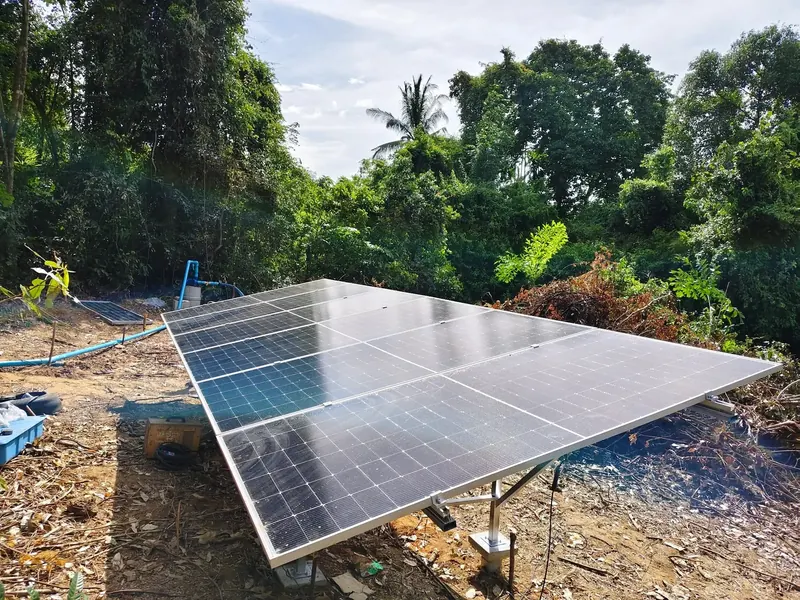
Choose by the work you do
Solar for crops and farm businesses in Southern Thailand
Each crop uses power differently and needs a different system design. Choose the work closest to yours for the details.
We serve 13 southern provinces. See our service areas
Two main options
A standalone solar pump set, or a grid-tied system
This choice affects cost more than the choice of equipment brand, and the answer depends on how far the plot is and how many months a year you use power.
A standalone solar pump set, no meter
Best for: Plots, ponds or fields away from the house, where grid power doesn't reach
The panels feed the pump through a controller, with no battery and no cable from the electricity authority. When the sun is out the pump runs; when the sun goes, it stops.
- No need to run power lines out to the pump — often a bigger cost than the solar system itself
- No new electricity meter and no grid connection application
- Suits orchards that only irrigate in one season, because you don't carry a large system all year
When the pump isn't in use, the power generated isn't used at all. This setup also usually needs a pump designed for the job, or an added controller that converts the power to suit your existing pump.
A grid-tied system on your farm buildings
Best for: Farms where a house, shed, packing house, smokehouse or rice mill shares a meter with the pump
Panels are added to the electrical system of your home or business, and the pump and machinery keep drawing power from that system as before.
- Your existing pump can stay — no replacement needed
- In months without irrigation, the power goes to the house, packing house or machinery instead of going to waste
- The pump can still run at night or in the rainy season, because grid power is still there
A grid connection application to PEA (the Provincial Electricity Authority) is required — we handle all of it for you.
Seasonal power use
Designed around a full year of use
Farms use different amounts of power from month to month — heavy in some seasons, almost nothing in others.
That's why we ask to see 12 months of past electricity bills, to see both the heavy months and the quiet ones, and recommend a size that fits your real use across the year.
If the numbers say a smaller system suits you better than you expected, we recommend the smaller system.
- Durian and fruit orchards
Irrigation pumps run almost every day in the dry season and are barely used through the rainy season.
- Packing houses
Heavy power use for only two to three months of the harvest season, and much lower use outside it.
- Rice fields and rice mills
Pumps follow the rice-growing season, while mills use power whenever there is rice to mill.
- Rubber businesses
During the leaf-shedding season, when tapping stops, the business uses almost no power — very different from the tapping season.
- Shrimp and fish ponds
Aerators run day and night. Panels help with the daytime share, and night-time power still comes from the grid.
Payback for work that uses most of its power in the daytime is around 4–7 years, estimated at THB 4.20 per kWh and Southern Thailand sunshine. Farms that use power only in certain seasons will differ — we calculate it for each plot before quoting.
Site conditions in the South
What we plan for at the design stage
Salt air, humidity and the conditions on southern farmland all affect how long a system lasts.
Salt air on the coast
For coastal ponds, lakeside ponds and fields near the sea, we use corrosion-resistant mounting structures and fasteners, seal every electrical connection tightly, and specify all of this at the design stage.
High humidity almost all year
Hillside orchards and the area around palm oil mills stay very humid. We set the tilt so water drains off, choose control cabinets with a high water and dust protection rating, and leave access for panel cleaning.
Acid fumes from rubber smokehouses
The acid used to coagulate latex, combined with smokehouse humidity, speeds up corrosion much like salt air. We use aluminum structures with stainless-steel fasteners and place the inverter away from the path of the fumes.
Low-lying land and soft soil
Control cabinets and inverters are mounted above the highest flood level the site has seen, and ground-mount foundations are designed to spread the load or use short piles — a cost we state in the quote.
Trees that grow taller every year
Rubber, oil palm, durian and coconut fronds cast strips of shade. We allow for the growth of the surrounding trees, group panel strings by the real shade, or use a ground-mounted frame in open ground.
Plots far from the house
We choose a spot that can be seen from the house or a road and use fixings that are hard to remove, and we talk this through with the owner during the site survey.
Read more in our article Solar Water Pumps for Rubber Plantations and Shrimp Ponds: How to Choose
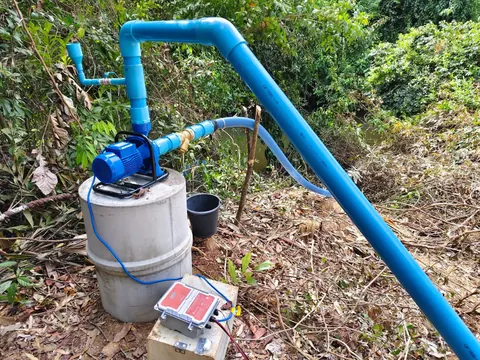
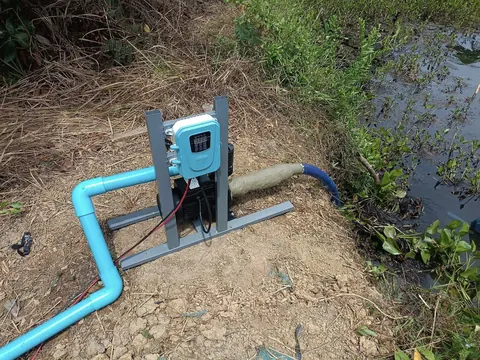
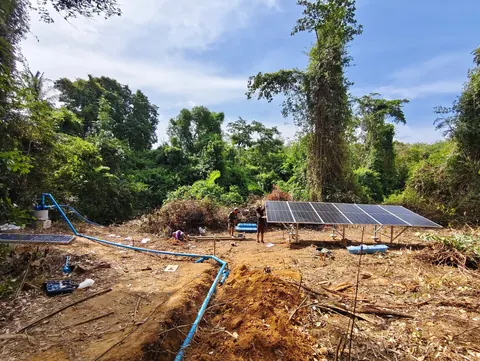
Pumping systems from our own job sites: a pump installed over a well with its control unit, a pump beside a water source, and panels laid out with water pipes running through the plot. See all projects
Warranty and site survey
Warranty by component, and an estimate from your bill first
Warranty by component
- Solar panels — product warrantySet by each panel manufacturer for the brand and model you choose, stated in your quotePer manufacturer
- Solar panels — power output warrantySet by each panel manufacturer for the brand and model you choose, stated in your quotePer manufacturer
- InverterMost major brands give 10 years, and it can be extended10 years
- Installation and mounting work by 19Energy19Energy's own technicians handle every job2 years
2 years of free aftercare: Panel cleaning once a year · Annual system health check · A check of your building's wiring while we are there. See warranty terms
Before a site survey
- A first estimate from your electricity bill is free — just send a photo of the bill on LINE.
- For pump work, send a photo of the pump's nameplate, how many hours a day it runs, and what kind of water source you pump from.
- A site survey costs THB 1,200–1,500, refunded in full against your quote when you go ahead with the installation.
- Site surveys are by appointment, and any travel charge is confirmed before booking.
FAQ
What farmers in the South ask us most
Should I choose a standalone solar pump set or a grid-tied system?
It comes down to whether grid power reaches the plot, and whether other loads share a meter with the pump. For plots without grid power, or orchards that only irrigate in one season, a standalone solar pump set usually costs less up front and needs no new meter. For farms where a house, packing house or shed shares the meter, a grid-tied system sends the power to those other loads in months without irrigation. We compare both options with you before you decide.
Our farm uses a lot of power only in certain seasons. Is solar still worth it?
It can be, when the system is designed around a full year of use. We look at 12 months of past electricity bills to see both the heavy months and the quiet ones, then recommend a size that fits. If the numbers say a smaller system suits you better than you expected, we recommend the smaller system.
Our rubber or oil palm plot has no buildings yet. Where do we start?
Solar pays off best when there is a load to use the power the moment it is generated. On a plot that uses only a few light bulbs, the right time is when a load arrives — for example newly planted trees that need watering in the dry season, which suit a solar pump set well, or when you add a smokehouse, buying yard or collection yard. We can tell you which applies to you when we look at your electricity bill, before you pay for a site survey.
Our shrimp ponds need aeration all night. Can solar help?
Yes. The panels carry the daytime load, and the aerators still have power at night, either through a connection to your existing supply or through a system with battery backup. A pump set that only runs while the sun shines is suited to pumping water into ponds during the day.
Our farm is near the sea. How long will the equipment last?
That depends on the materials chosen at the design stage. We use corrosion-resistant structures and fasteners, seal every connection, and place the inverter in the shade away from water spray. Regular panel cleaning also matters, because salt deposits stick firmly and block more light than ordinary dust.
Can we keep our existing pump?
With a system connected to your home supply, yes — no replacement needed. With panels wired directly to the pump, you usually need a pump designed for the job, or an added controller that converts the power to suit your existing pump. Send us a photo of the nameplate on your pump and we'll tell you whether it can be used.
What does the site survey cost, and what is the warranty?
A first estimate from your electricity bill is free — just send a photo of the bill on LINE. You can also send a photo of your pump's nameplate. A site survey costs THB 1,200–1,500, refunded in full against your quote when you go ahead with the installation. Site surveys are by appointment, and any travel charge is confirmed before booking. Installation and mounting work by 19Energy is covered for 2 years — 19Energy's own technicians handle every job. Panel warranties are per manufacturer for the brand and model you choose, as stated in your quote.
Send us your bill or a photo of your pump's nameplate
We'll give you a first estimate of which type of system suits your farm and what size it should be, before you decide on a site survey.
Read before you decide
- Solar Water Pumps for Rubber Plantations and Shrimp Ponds: How to ChoosePumps run during the day, exactly when panels produce power, and their timing is flexible — which makes them one of the most cost-effective uses of solar.
- Solar for Homes Near the Sea: What You Need to Know About Salt Air and CorrosionYou can install near the coast, with salt-resistant materials chosen at the design stage.
- On-Grid, Off-Grid or Hybrid Solar: What's the Difference and Which Suits You?The difference comes down to whether the system connects to the utility grid and whether it can store power — which changes both the price and the value.