Solar water pumps for farms
Water pumps run during the day — exactly when panels produce the most — and their timing is flexible. That makes pumping one of the most cost-effective uses of solar power.
Why it pays off
One of the best loads to pair with solar
There are two reasons. First, pumps naturally run in the daytime because of the work they do. Second, the time you water or pump is usually flexible — it doesn't have to happen at one particular hour.
That flexibility is valuable, because it lets you move your power use into the hours when the panels produce the most — unlike, say, the air-conditioning at home, which has to run when people are there.
The result is that almost all the power generated is used on the spot, without relying on selling electricity back to the grid.
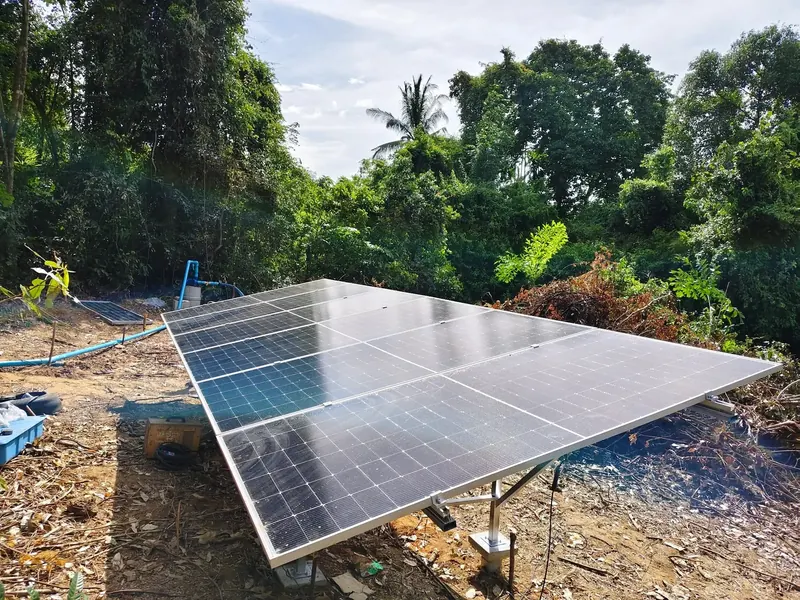
Two options
Which one? It depends on whether grid power reaches your plot
The two differ a great deal in permits, cost, and what they can do when there's no sun.
Connected to your existing power supply
Best for: Plots close to the house that already have grid power
Panels are added to the electrical system of your home or business, and the pump keeps drawing power from that system as before.
- Your existing pump can stay — no replacement needed
- On days the pump isn't running, the power goes to other things in the house instead of going to waste
- The pump can still run at night or in the rainy season, because grid power is still there
A grid connection application to PEA (the Provincial Electricity Authority) is required — we handle all of it for you.
Panels wired directly to the pump
Best for: Plots, ponds or fields away from the house, where grid power doesn't reach
The panels feed the pump through a controller, with no battery and no cable from the electricity authority. When the sun is out the pump runs; when the sun goes, it stops.
- No need to run power lines out to the pump — often a bigger cost than the solar system itself
- No new electricity meter needed
- No grid connection application, because the system never connects to the electricity authority's lines
When the pump isn't in use, the power generated isn't used at all. This setup also usually needs a pump designed for the job, or an added controller that converts the power to suit your existing pump.
What we install
The pumping systems we install most often in the South
Rubber and oil palm plantations
Watering through the dry season and for new plantings. You choose when to do it, so all of it can be shifted to the sunniest hours.
Rice fields and field crops
Pumping water into the fields in cycles. The volume needed per cycle decides the system size more than the size of the land.
Shrimp ponds and aquaculture
Both pumping water in and out and running paddle-wheel aerators. Where aeration has to run 24 hours a day, the design must still provide power at night.
Boreholes and local water supply
A submersible pump in a borehole can only be sized correctly once the real depth of the well and the water level are known.
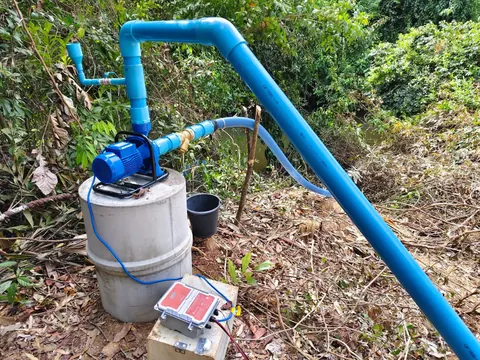
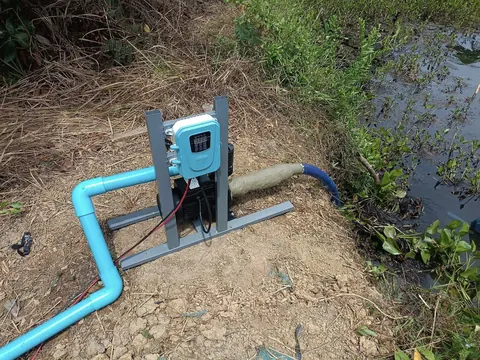
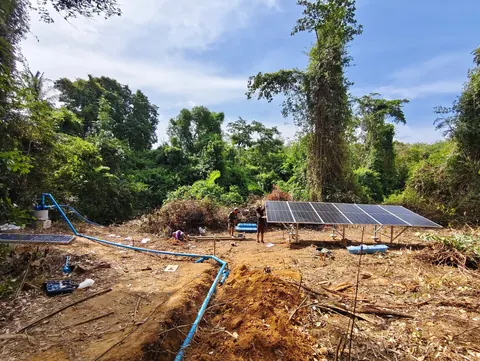
Pumping systems from our own job sites: a pump installed over a well with its control unit, a pump beside a water source, and panels laid out with water pipes running through the plot. See all projects
Before we estimate
Four things we need to know to size your system
With these four pieces of information, we can give you a first estimate over LINE before booking a site survey.
How many watts does your pump use?
The power rating is printed on the nameplate on the pump. You can simply send us a photo of it.
How many hours a day does it run, and at what time?
This decides how many panels you need, and whether you need energy storage.
Where do you pump from, and where does the water go?
A borehole, a canal or a surface pond — and how far the water has to travel, both the height it is lifted and the length of the pipe.
Is anything shading the spot where the panels will go?
Including trees that aren't tall yet but will grow in the next few years — a common issue on plantations and orchards.
The right system size comes from how much water you actually need each day, not from the size of the land. A large plot watered once a week may need a smaller system than a small plot that has to be pumped every day.
What to plan for on farms in Southern Thailand
- Shrimp ponds that need aeration 24 hours a day aren't suited to a system that only works while the sun shines — the design has to keep power available at night.
- Remote plots carry a risk of theft, so the location of the panels and how they are fixed should be planned with this in mind from the start.
- Sites near the sea, such as coastal shrimp ponds, need salt-resistant equipment chosen at the design stage.
- Trees that are short today can shade the panels in a few years, so panel placement has to allow for the growth of the plants around them.
Read more in our article Solar water pumps for rubber farms and shrimp ponds: how to choose
FAQ
Solar-powered water pumping
Can my existing pump be used with solar?
With a system connected to your home supply, your existing pump works as it is — no replacement needed. With a set that wires the panels directly to the pump, you usually need a pump designed for the job, or an added controller that converts the power to suit your existing pump. We can tell from the nameplate on your pump whether it can be kept.
Does a solar pump system need a permit from the electricity authority?
A set that wires the panels directly to the pump needs no permit application, because it never connects to the electricity authority's distribution network. But as soon as you connect it to your home's electrical system, a grid connection application is required through the normal process — which we handle for you from start to finish.
In the rainy season I don't need to water. Will the panels go to waste?
With a system connected to your home supply, the power goes to other uses instead, so nothing is wasted. With a stand-alone solar pump set that isn't connected to anything, the power isn't used while the pump is idle. That drawback has to be weighed against the convenience of not running power lines out to the plot.
My plot is far from the house. What about theft?
It's a common and well-founded concern. Good design helps to a degree: placing the panels where they can be seen from the house or a road, and fixing them in a way that is hard to remove without special tools. We discuss this with the landowner during the site survey.
Can solar run a shrimp pond that needs aeration all night?
Yes, but not with a system that only works while the sun shines. This kind of job has to be designed so power is still available at night — either by connecting to an existing power supply or with a battery backup system. The right choice depends on whether grid power already reaches the site.
How much does installation cost?
It depends on the pump's power, the distance the water has to be pumped, and where the panels will go — which can vary a lot even between similar jobs. Quotes are therefore based on an actual site survey. The site survey carries a fee of THB 1,200–1,500, refunded in full against your quote when you go ahead with the installation.
Start with a photo of your pump's nameplate
Tell us the pump's power rating, how many hours a day it runs and what kind of water source you have. We can give you a first estimate of how many panels you need and which type of system suits you, before you decide to book a site survey.
Our team replies in English — on LINE, by email or by phone. Sending a photo of your electricity bill and your location on LINE is the quickest way to get an estimate.
Read before you decide
- Solar Water Pumps for Rubber Plantations and Shrimp Ponds: How to ChoosePumps run during the day, exactly when panels produce power, and their timing is flexible — which makes them one of the most cost-effective uses of solar.
- On-Grid, Off-Grid or Hybrid Solar: What's the Difference and Which Suits You?The difference comes down to whether the system connects to the utility grid and whether it can store power — which changes both the price and the value.
- Monthly Bill of THB 3,000, 5,000 or 10,000 — What Size Solar System Do You Need?The best-value size is not the largest your roof can hold — it is the size that matches the electricity you use during the day.