Warehouse & Logistics Solar in Southern Thailand
For warehouses, transport firms, garages and piers. Warehouses, transport firms and garages work in the daytime and have large roofs. Daytime businesses pay back in around 4–7 years, under the conditions below — but older roofs must pass a structural check first.
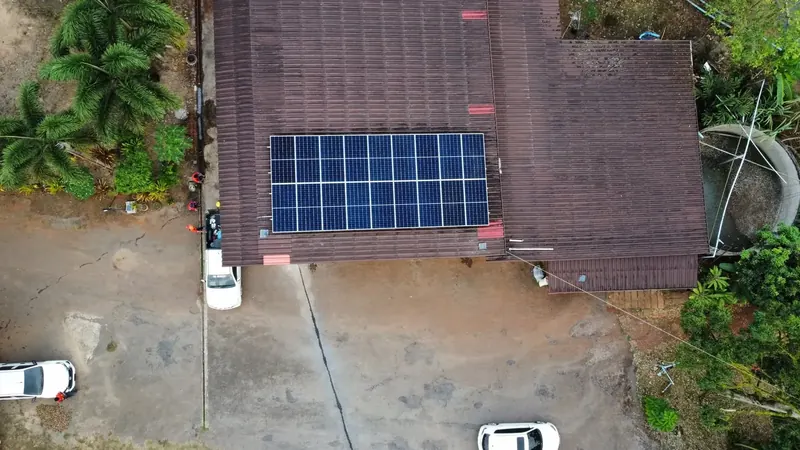
A building rooftop installed by our own team.
How the business uses power
The roof space is there — the question is daytime load
Warehouses and transport buildings usually have wide-span metal roofs with room for many panels. But the right system size isn't set by roof area — it's set by how much power the business uses in the daytime, because businesses on commercial meters can't sell surplus power back.
Warehouses with cold rooms, conveyors or air-conditioned offices, and garages running compressors and welders all day, use almost everything as it is generated, so each unit is worth the full rate of around THB 4.20 per kWh. A store that only uses lighting needs a correspondingly smaller system.
Loads that can be moved in time — such as charging electric forklifts — use more solar power if charging can shift to the daytime.
Main loads by business type
| Business | Main loads | Solar fit |
|---|---|---|
| Warehouse with cold rooms | Compressors running continuously | Very good |
| Warehouses and loading yards | Lighting, conveyors, offices | Depends on load |
| Garages and workshops | Compressors, welders, car lifts | Good |
| Pier businesses | Cold rooms, water pumps, offices | Good |
Businesses that use most of their power in the daytime pay back in around 4–7 years. Estimated at THB 4.20 per kWh and Southern Thailand sunshine (1,350 kWh per kWp per year, rainy season included). Actual payback depends on your bill and when you use electricity — we calculate it for your property before quoting.
Who it suits
Solar for warehouses, transport firms, garages and piers
Warehouses and distribution
Wide-span roofs carry large systems. Best value when there are cold rooms, conveyors or offices using power in the day.
Transport firms and container yards
Working full days, with electricity as a fixed monthly cost, and unable to stop during the working day.
Garages and workshops
Air compressors, welders and car lifts run in the daytime, when the panels are generating.
Piers and boat businesses
Cold rooms, ice plants and water pumps around piers run continuously, but need salt-resistant equipment.
Districts where these businesses cluster
Thung Song, Nakhon Si Thammarat
The South's largest rail junction, with warehouses, loading yards and repair garages. Roofs are wide-span metal sheet, but older warehouses were often designed only for the original roof's weight.
Solar in Nakhon Si ThammaratSadao, Songkhla
The border crossing with Malaysia, with warehouses, container yards and freight operators. These businesses can't stop during working hours, so power-cut work is scheduled outside them.
Solar in SadaoPhunphin, Surat Thani & Koh Samui
Home to Surat Thani railway station and close to the airport, with warehouses and loading yards. It sits on the Tapi River, which has flooded in some years, so inverters and control cabinets are raised above flood level.
Solar in Surat Thani & Koh SamuiHuai Yot, Trang
Where several main roads meet, with transport firms and warehouses. Wide-span roofs need their purlins checked every time.
Solar in TrangMueang Chumphon, Chumphon
Warehouses and transport firms along the southbound route, on a coast that takes Gulf storms. Fixings should transfer load to the main structure, not rely on purlins alone.
Solar in ChumphonRon Phibun, Nakhon Si Thammarat
Repair garages and daytime businesses along the main road between Mueang Nakhon Si Thammarat and Thung Song.
Solar in Nakhon Si ThammaratRattaphum, Songkhla
Transport operators on the route from Hat Yai toward Satun and Trang. The Banthat foothills are cloudier, so we calculate with the local sunshine figure.
Solar in SongkhlaKantang, Trang
A river port on the Trang River, with pier businesses, fishing and cold storage. Humidity and salt are high, so corrosion-resistant equipment is chosen at the design stage.
Solar in TrangSinghanakhon, Songkhla
Home to Songkhla deep-sea port, taking salt air from both the lake and the Gulf. Corrosion-resistant equipment is standard on every job.
Solar in SongkhlaDon Sak, Surat Thani & Koh Samui
The ferry piers for Koh Samui and Koh Pha Ngan. Tall light masts, cranes and yard canopies cast long shadows in the morning and evening, and are included in the shade assessment.
Solar in Surat Thani & Koh SamuiMueang Satun, Satun
Home to Tammalang pier, with fishing businesses and cold storage. Mangrove humidity is high, so connections are sealed more tightly than inland.
Solar in SatunLa Ngu, Satun
Home to Pak Bara pier and its tour-boat businesses. Trade is strongly seasonal; the months when boats stop running are a window for installation that doesn't disrupt work.
Solar in Satun
We serve 13 provinces in Southern Thailand. Site surveys are by appointment, and any travel charge is confirmed before booking. See all service areas
Design points
What to check on warehouse, garage and pier roofs
Purlins and rafters checked on every job
Wide-span metal roofs have room for large systems, but older warehouses were often designed only for the original roof's weight. An engineer certifies the structure in writing.
Solar on metal sheet roofsKeep clear of translucent sheets
Many warehouses have translucent roof sheets for daylight. Panels can't cover them if you still need the light, and they can't be walked on — the layout works around them.
Cables and cabinets out of the way
Inverters, control cabinets and cable routes must not block forklift lanes, loading doors or storage areas, and must stay easy to reach for maintenance.
Flood-prone sites
For riverside warehouses that have flooded before, inverters and control cabinets are raised above the highest flood level recorded at that site.
Piers and the seafront
Salt and humidity speed up corrosion, so mounting and connections must resist it, and wind loads are calculated for open seafront exposure.
Solar near the sea and salt airGarages: dust and paint mist
Spray painting and sanding dirty panels faster than on ordinary buildings. Panels should sit away from paint-booth exhausts, with more frequent cleaning.
Panel cleaning serviceTax and accounting
The tax questions accounts teams ask before approving
Tax invoices and withholding tax
- 19Energy is a VAT-registered company and issues full tax invoices in your company's name.
- 3% withholding tax works as normal for corporate clients.
- Every quote states whether prices are before or after VAT.
- The system is an asset that can be depreciated under normal accounting rules; ask your accountant for the exact tax effect for your business.
1.5x deduction on equipment cost
Under Royal Decree No. 805 of 2026, which runs until the end of 2028, companies and people with business income can deduct 1.5 times the equipment cost as an expense. Only the equipment counts — installation labor is not included — and these conditions apply:
- The equipment must be new and never used before
- The equipment must carry the No. 5 energy-efficiency label as specified by the authorities
- It cannot be claimed on top of other investment-promotion measures
Confirm with your accountant how this applies to your business before deciding. Read the full 2026 solar tax deduction rules
System sizes
System sizes for warehouses, garages and piers
We don't publish prices, because the real cost depends on the roof type, structure and cable runs. We quote after the site survey.
10 kW
16 panels · about 45 m² of roof · single-phase or three-phase
Large homes, pool villas, shops and daytime businesses
Shops, offices, pool villas and large homes that use power steadily through the day. The best return per baht invested. Single-phase homes can take it if the meter allows — we check the meter size first.
10 kW system details15 kW
24 panels · about 68 m² of roof · three-phase
Small factories, hotels and commercial buildings
Businesses that run all day use almost every unit the moment it is generated, so they pay back noticeably faster than homes.
15 kW system details20 kW
32 panels · about 90 m² of roof · three-phase
Factories, cold storage and buildings with heavy all-day loads
Continuous loads such as cold rooms, large pumps and production lines — every unit generated gets used.
20 kW system detailsLarger systems are designed project by project from the real load. Examples of our on-grid work include a 35 kW system in Tha Chang and a 760 kW project spread across several building roofs.
Equipment and warranty
Named brands you can check, warranties listed by component
Equipment we install
- Solar panels: JA Solar, LONGi or Jinko Solar · N-type TOPCon, dual-glass, 620–630 W per panel
- Inverters: HUAWEI, Solis or Deye · On-grid and hybrid inverters with a monitoring app so you can check your generation history yourself
- Batteries (hybrid systems): LVTopsun or Sunwoda · LiFePO4 lithium batteries for hybrid systems, sized to your night-time consumption
The exact brand and model are written into your quote before you sign anything.
Warranty by component
Solar panels — product warranty
Set by each panel manufacturer for the brand and model you choose, stated in your quote
Solar panels — power output warranty
Set by each panel manufacturer for the brand and model you choose, stated in your quote
Inverter
Most major brands give 10 years, and it can be extended
Installation and mounting work by 19Energy
2 years · 19Energy's own technicians handle every job
Manufacturer warranties follow the documents for the exact model installed. See warranty terms by brand
2 years of free aftercare
- Panel cleaning once a year
- Annual system health check
- A check of your building's wiring while we are there
We contact you 14days ahead of each visit and can book a day that doesn't clash with your loading work.
Bill review first, then the site survey
- A first estimate from your electricity bill is free — just send a photo of the bill on LINE.
- The on-site survey costs THB 1,200–1,500 for sites within 100 km, and it is refunded in full against your quote when you go ahead with the installation. It covers fuel, a technician's full day away from installation work, and the time to measure, calculate and write up your report.
- Site surveys are by appointment, and any travel charge is confirmed before booking.
We handle the paperwork with the PEA and the ERC. PEA permit service
FAQ
Questions from warehouse, garage and pier owners
Can an old warehouse roof take the weight of panels?
An engineer has to check it every time. Panels plus mounting weigh around 12 to 15 kg per square meter, and older warehouses were often designed only for the weight of the original roof. We check the purlins and rafter spacing first, and have an engineer calculate and certify the structure in writing — a document that is also needed for the permit applications.
What is the payback for warehouse solar?
Businesses that use most of their power in the daytime pay back in around 4–7 years. But some warehouses use little power in the day — for example, a store with only lighting that already gets daylight through translucent roof sheets. Those need a smaller system sized to the real load. Warehouses with cold rooms, conveyors or air-conditioned offices use almost everything they generate. Estimated at THB 4.20 per kWh and Southern Thailand sunshine (1,350 kWh per kWp per year, rainy season included). Actual payback depends on your bill and when you use electricity — we calculate it for your property before quoting.
Is solar worth it for a car repair garage?
Garages work in the daytime and have heavy loads — air compressors, welders, car lifts and office air-con — that run while the panels generate. How worthwhile it is depends on how continuously those loads run, which we check from past bills before proposing a size. Garages that do spray painting or sanding should plan more frequent panel cleaning than ordinary buildings.
Can you install while the warehouse keeps working?
Yes. Roof work goes ahead while the warehouse operates. Power only has to be cut briefly while we connect to the main switchboard and when the PEA changes the meter. We schedule these outside working hours and tell you the power-cut times in advance, at the quotation stage.
Do pier and seafront businesses need special equipment?
Corrosion-resistant mounting and connections are standard, and connections are sealed more tightly than inland. Open seafront sites also need higher wind loads allowed for, and the shade assessment has to include tall light masts, cranes and yard canopies.
What permits are needed?
There is a grid-connection application to the Provincial Electricity Authority (PEA); systems under 1,000 kVA file a license-exemption notice with the Energy Regulatory Commission (ERC), while larger systems need a full license. If the installed area or weight exceeds the ministerial-regulation thresholds, a building-modification permit is also needed, and businesses on commercial meters must install equipment that prevents power flowing back into the grid. We handle these for you.
Do you issue tax invoices, and is there a tax benefit?
We issue full tax invoices and support 3% withholding tax for corporate clients. Under Royal Decree No. 805 of 2026, companies and people with business income can deduct 1.5 times the equipment cost as an expense; installation labor is not included. The equipment must be new and carry the No. 5 energy-efficiency label, and the deduction cannot be combined with other investment-promotion measures. The measure runs until the end of 2028. Confirm how it applies to your business with your accountant.
Request a quote for your warehouse or business
Send us your past electricity bills and working hours. We will propose a system size with the assumptions behind it laid out for you to check.
Our team replies in English — on LINE, by email or by phone. Sending a photo of your electricity bill and your location on LINE is the quickest way to get an estimate.
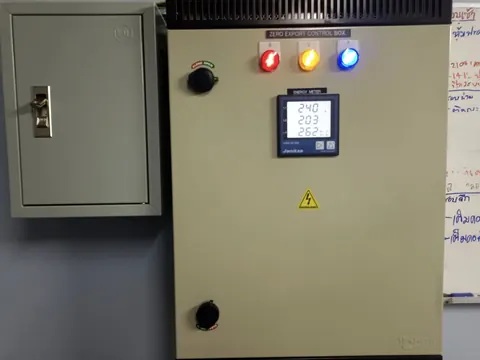
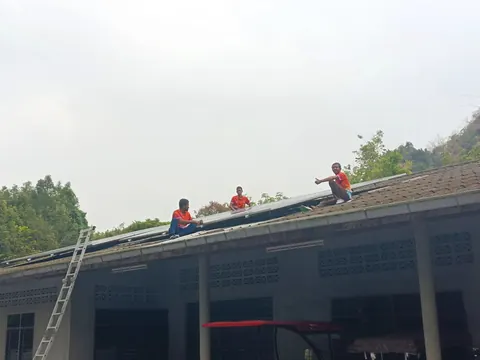
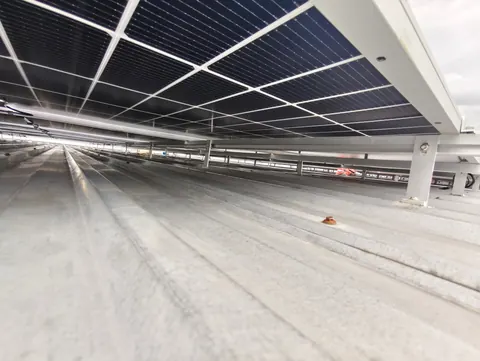
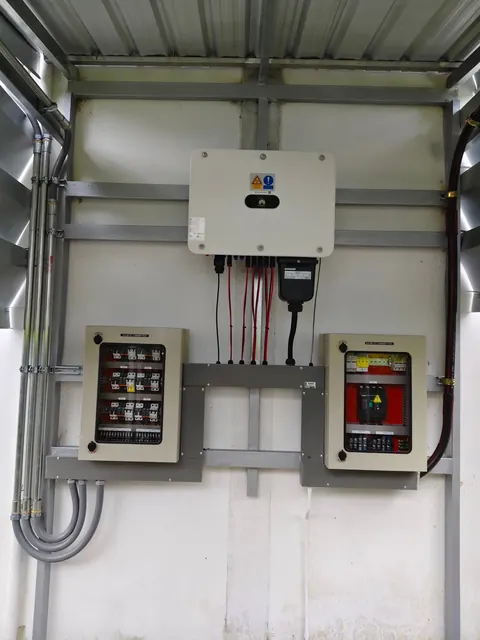
Factory and commercial projects installed by our own team. See all projects
Read before you decide
- Check Your Roof Before Going Solar: Which Roofs Need Repair FirstSolar panels stay on your roof for twenty-plus years. If the roof underneath has only a few years left, or already leaks, you want to know and fix it before installation — fixing it afterward means taking the panels down first.
- Solar for Homes Near the Sea: What You Need to Know About Salt Air and CorrosionYou can install near the coast, with salt-resistant materials chosen at the design stage.
- Is Solar Worth It for Cold Storage and Ice Plants?Compressors that run all the time are the load that absorbs daytime solar power best — and cold storage is a core industry in Songkhla and Nakhon Si Thammarat.