Solar for Durian and Fruit Orchards
The main load in a durian orchard is irrigation, which runs hard in the dry season and stops in the rainy season. Sizing a system from your peak month's bill almost always gives you a system bigger than you need.
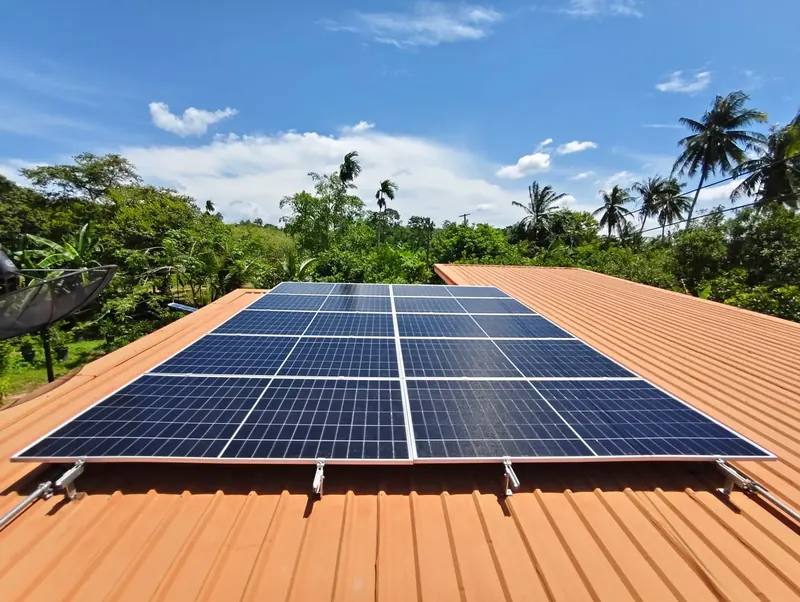
Water pump and agricultural work by our team
What makes orchards different
Heavy power use for half the year, not all year
Durian orchards run their irrigation pumps almost every day in the dry season, then barely use them at all through the rainy season. Packing houses and sorting sheds use heavy power for only two to three months of the harvest.
If you size the system from your peak month's bill, you end up with a system bigger than you need for the rest of the year, and it pays back much more slowly than it should.
We calculate from a full year of electricity bills, and if the numbers say you should install something smaller than you had in mind, we'll tell you so.
Points to check when sizing
Sizing from the pump you already have
Pumping uphill takes far more power than pumping on the flat. It has to be calculated from the real lift height, not just the size of the old pump.
Sizing from the peak month's bill
You get a system that is too big for the other ten months. A full year of bills gives the right picture.
Combining the pump and the house on one system
You carry a large system all year to cover a use that lasts half the year. A separate set is often better value.
Forgetting that lights and cameras run at night
A system that only works while the sun is out has no power at night. This part needs its own battery.
The loads we design for
Where an orchard's electricity goes
We size the system from these real loads, not from how much empty roof space there is.
Pumping water uphill
Most durian orchards sit on hillsides, so the pump has to lift water to higher ground, which takes far more power than pumping on the flat, even at the same flow rate. This is the single biggest load in the orchard.
Sprinklers and mini-sprinklers
They run in cycles every day in the dry season, and can be shifted entirely into the sunniest hours, so almost none of the solar power goes to waste. This is the load that suits solar best in an orchard.
Fertigation and chemical dosing
Dosing pumps and mixing tanks run together with the irrigation cycle. It's an extra load at the same time of day, so it doesn't add much to the system size — but it has to be counted in the calculation.
Packing-house cold rooms and sorting lines
Packing houses and sorting sheds use very heavy power for only around two to three months of the harvest season, then almost none outside it. That usage pattern needs a design of its own.
Spray pumps and orchard tools
Used now and then as part of routine care. Not a main load, but power is needed at points the grid doesn't reach.
Security lights and cameras
Durian orchards often put up lights and security cameras as harvest approaches. These are night-time loads, so they need a system with a battery, not one that only works while the sun is out.
Payback for systems whose power is used mainly in the daytime is around 4–7 years, estimated at THB 4.20 per kWh and Southern Thailand sunshine. Orchards that use power only in certain seasons will differ; we calculate it for each plot before we quote.
Design options
A separate pump set, or one combined system?
This question affects the cost more than your choice of equipment brand, and the answer depends on how far away the plot is and how many months a year it uses power.
A separate pump set suits plots without grid power
No new meter, no grid-connection application, and a lower upfront cost than running power lines into the plot.
A separate pump set suits seasonal use
You don't carry a large system all year just to cover half a year of use.
One combined system suits orchards with a house or packing house on the plot
Other loads use the power all year round, so nothing goes to waste even in the months you don't irrigate.
Either way, the lift height has to be measured
We measure from the pump position to the highest outlet on the plot on every site survey — never estimated from a map.
FAQ
What fruit orchard owners ask us most
Can I keep my existing pump, or do I need a new one?
It depends on the type of pump you have. If it's a standard mains pump connected to your meter, we can design the solar system to feed your existing supply without replacing the pump. If the pump is somewhere the grid doesn't reach and you want to run it directly from a solar pump set, you usually need a pump designed specifically for that. We'll tell you clearly which case applies to you during the site survey.
My orchard is on a slope. How do you size the system correctly?
It has to be calculated from the real height the water must be lifted, plus the length and diameter of the pipes — not just from the size of the pump you use now. On hillside orchards this decides whether the system can push water up to the highest point of the plot. We measure the height from the pump position to the highest outlet on every site survey.
We don't irrigate at all in the rainy season. Will the power go to waste?
If it's designed as one system combined with the house supply, yes, it will. The system has to be big enough for the dry season and then sits with spare capacity for the other half of the year. That's why we usually recommend a separate solar pump set, apart from the house system. You don't carry a large system all year for a use that happens only half the year, and the upfront cost is lower too.
Our packing house runs heavy loads for only two months. What size should we install?
We don't recommend sizing it from your peak month's bill. If you size the system to the month when the cold rooms run at full capacity, you end up with a system far bigger than you need for the other ten months, and it pays back much more slowly than it should. We calculate from a full year of electricity bills and design the system to make sense in both the peak and the off-season. If the numbers say you should install something smaller than you had in mind, we'll tell you so.
Tall durian trees block the sun. Where can the panels go?
Mature durian trees are tall with wide canopies, so house or shed roofs in the middle of an orchard are often shaded in strips all day. In that case a ground-mounted frame in an open area beside the plot usually works better than forcing panels onto a roof under the trees. It can also be turned to face the sun better than a roof whose direction is already fixed by the slope of the land.
We also want lights and security cameras at night.
That needs a system with a battery. A system that only produces power while the sun is out has nothing to give at night. We can design it in two parts: a pump set that runs in the daytime with the sun, and a small battery-backed set for the lights and cameras. Those use far less power, so the battery doesn't need to be large.
The orchard is far from the house and has no grid power. Can you still do it?
Yes, and it's often better value than bringing grid power in. Running power lines to a plot far from the distribution line is very expensive and needs a new meter as well. A solar pump set placed right where the water is used needs no meter and no grid-connection application, because it isn't connected to the utility supply at all.
Other farm work
Other crops we install solar for
Each crop uses power differently, and each needs a different system design.
Tell us how high your plot is and how many months you irrigate
Those two things decide the system size more than the number of rai. We'll run the numbers for you first at no charge, with every assumption laid out so you can check it.
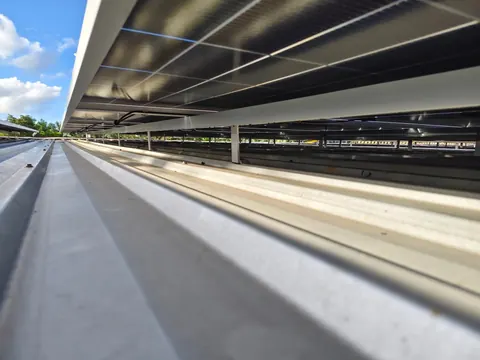
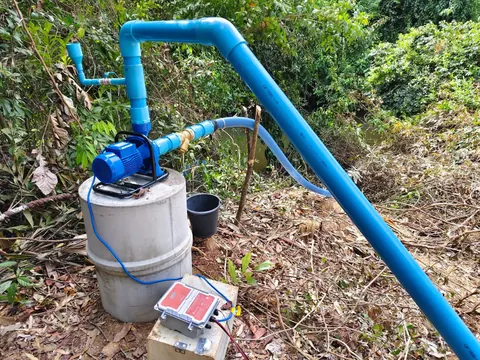
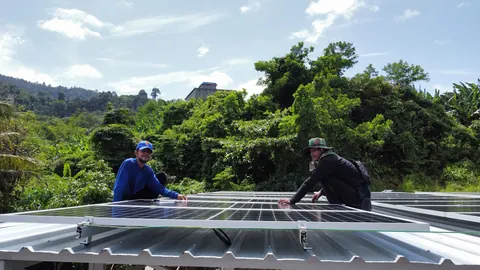
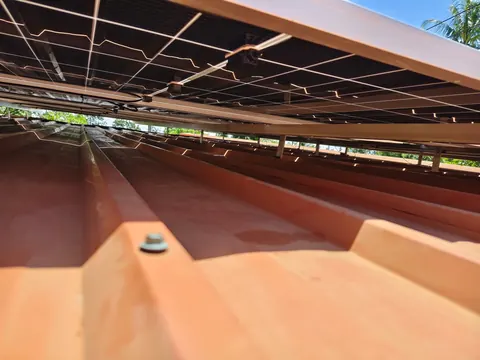
Water pump and irrigation work on agricultural land. See all projects
Read before you decide
- Solar Water Pumps for Rubber Plantations and Shrimp Ponds: How to ChoosePumps run during the day, exactly when panels produce power, and their timing is flexible — which makes them one of the most cost-effective uses of solar.
- Can Lightning Strike Solar Panels? The Protection You Need in Southern ThailandRooftop panels don't attract lightning the way many people fear, but surge damage from a nearby strike is real — and it can be prevented.
- Monthly Bill of THB 3,000, 5,000 or 10,000 — What Size Solar System Do You Need?The best-value size is not the largest your roof can hold — it is the size that matches the electricity you use during the day.