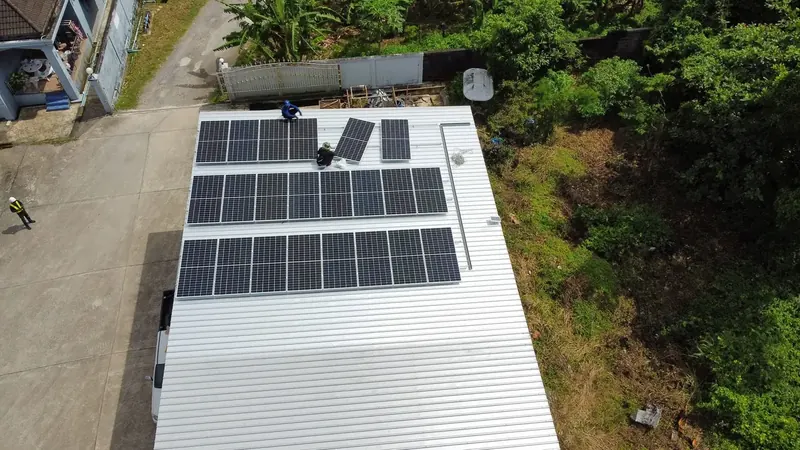
Phatthalung, Nakhon Si Thammarat and Trang are farming areas that use water pumps routinely — for irrigating rubber and oil palm plantations and for aerating shrimp ponds. It is one of the uses of electricity best suited to solar.
Why pumps and solar work so well together
There are two reasons. First, pumps naturally run during the day because of the nature of the work. Second, the time for watering or pumping is usually flexible — it doesn't have to happen at one particular time.
That flexibility is very valuable, because it lets you move your power use into the hours when the panels produce the most — unlike loads such as home air-con, which has to run when people are there.
Two very different options
Connecting to your existing electricity supply
If you already have a meter and electrical supply, installing an on-grid solar system on it and letting the pump draw from the combined supply is the most flexible approach, because the power produced can also be used for other things in the house when the pump isn't running.
This suits properties where the house and the plot are close together and grid power is already available.
A dedicated solar pump
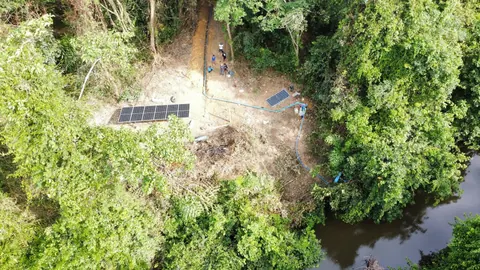
A kit in which the panels connect directly to the pump through a controller. It needs no battery and no grid connection: when the sun is out, the pump runs; when the sun goes, the pump stops.
It suits plots far from the house where the grid doesn't reach, which is common for rubber plantations spread over several sites. The advantage is that you don't need a new meter or a grid-connection permit, because it is not connected to the utility's lines at all.
A standalone solar pump system that is not connected to the grid does not need a grid-connection (parallel operation) permit, because it does not connect to the distribution network. But as soon as you connect it to your household supply, the normal application process applies.
Precautions specific to farm installations
- Shrimp ponds that need aeration 24 hours a day are not suited to systems without backup power, because the aerators must keep running at night. They need a grid-connected system or a backup source.
- Remote plots risk panel theft. Design the mounting so the panels are hard to remove, and place them where they can be seen from the house.
- Coastal areas such as seaside shrimp ponds need salt-resistant equipment, which is worth planning for from the start.
- Growing trees may shade the panels within a few years, so choose the location with the growth of surrounding plants in mind.
Where to start
Start by noting how many watts your pump draws, how many hours a day it runs, and at what time of day. Those three figures are enough for a first estimate of how many panels you need.
If you don't know the figures, the pump's rating plate shows its power — or just take a photo and send it to us.
Frequently asked questions
Can my existing pump be used with solar?
With an on-grid system connected to your household supply, your existing pump works as it is — no need to replace it. With a dedicated solar pump kit that connects the panels directly to the pump, you usually need a pump designed for that purpose, or a controller that converts the power to suit your existing pump.
In the rainy season I don't need to irrigate. Will the panels go to waste?
With an on-grid system connected to your household supply, the power produced is used by other things in the house instead, so nothing is wasted. With a standalone solar pump kit that isn't connected to anything else, the power really does go unused when the pump isn't needed — a drawback to weigh against the convenience of not running cables out to the plot.
Related services and areas
Keep reading
- On-Grid, Off-Grid or Hybrid Solar: What's the Difference and Which Suits You?The difference comes down to whether the system connects to the utility grid and whether it can store power — which changes both the price and the value.
- How Often Should You Clean Solar Panels, and Why Is the South Different?Rain washes off dust, but not bird droppings or algae — and a small patch of grime cuts output more than a thin film of dust spread across the whole panel.