Solar panel cleaning and system checks
Output that slowly slips away is money lost without you noticing, because nothing visibly breaks. We clean and inspect your system in a single visit, and report the figures before and after.
Installed by us? This service is free for 2 years
- Panel cleaning once a year
- Annual system health check
- A check of your building's wiring while we are there
We schedule the visits ourselves and contact you 14 days ahead, so there's nothing for you to remember. The cost is already included in the installation price — nothing is charged later.
The problem you can't see
One patch of dirt can pull down a whole panel's output
A panel is made of dozens of cells wired in series, working like water flowing through a line of pipes. If one point is shaded, the current of the whole string is limited to that weakest point.
So a single palm-sized bird dropping can cut a panel's output more than a thin, even layer of dust across the whole surface.
And because nothing breaks — no red light, no alarm — most owners don't notice until they look back at the generation figures.
What the rain can't wash off
The South has the advantage of rain that rinses away dust. But there are three kinds of grime the rain can't shift — and these are the ones that really cut output.
Bird droppings
They stick hard and block light completely — one spot affects the whole panel.
Moss and mold
They start along the frame edges in humid areas and slowly spread inward.
Salt deposits
In coastal areas, salt spray dries into a white film that bonds harder every time.
Scope of work
One visit, six checks
We don't just clean. Once we're on the roof, inspecting the system at the same time adds almost no time — but it catches problems before they become big ones.
Clean the panels with fresh water and glass-safe tools
Soft brushes and fresh water only — no corrosive cleaning agents, which strip the surface coating that helps light pass through the glass.
Check every mounting point and screw
We look for rust, loose fixings and perished rubber washers — the cause of both roof leaks and panels coming loose in strong wind.
Check cables and connectors
Cracked insulation, loose connectors and signs of heat build-up are early warnings that come before bigger problems.
Check the control cabinet and protective devices
We test that the breakers and surge protection still work, and that no moisture has got into the cabinet.
Check the roof around the installation
Signs of leaks, cracked tiles and the condition of the purlins wherever they are visible.
Read the generation history
The inverter's charts reveal problems you can't see with the naked eye, such as individual panels producing less than the rest.
When the work is done, we send you a report with photos from the site and before-and-after output figures from the inverter app, so you can see how much difference the cleaning actually made.
We also look after systems installed by others
An existing system still needs regular panel cleaning and checks, whoever installed it. We can take over its care.
We start by inspecting the existing system, then tell you — with photos — what should be fixed, what can be left alone, and what we recommend not touching because it would affect the manufacturer's warranty terms.
If the existing system is working well, our report says so.
FAQ
Cleaning and system care
How often should solar panels be cleaned?
In Southern Thailand the rain washes off some of the dust. A home in town without large trees nearby usually needs cleaning once a year; homes surrounded by trees or on the coast should clean 2 to 3 times a year. A more accurate method than counting is to watch the output in your app — if the numbers slowly fall while the weather stays much the same, it's time.
Do you clean systems installed by other companies?
Yes, and it's work we do often. We can take over the care of systems installed by others, and we'll tell you — with photos — what should be fixed and what can be left as it is.
Can I clean the panels myself?
Yes, if the roof is safe to reach and you have proper fall protection. Use fresh water with a soft cloth or soft brush, and clean early in the morning or in the evening, because hot glass hit by cold water can crack. Avoid scraping off grime with anything sharp, and avoid corrosive cleaners. Safety comes first — a wet roof is far more slippery than it looks.
Why check the system too, not just clean it?
Because the most expensive solar problems develop gradually with nothing visibly broken: screws working loose bit by bit, a connector whose resistance rises until heat builds up, or a single underperforming panel dragging down the whole string. All of these can be checked in the same visit while we're up there cleaning.
How much does it cost?
It depends on the number of panels, the height and pitch of the roof, and the distance. We give you the price before any work starts. Contact us with the number of panels and a description of the roof, and we can give you an estimate straight away.
Read our article on how often to clean panels in Southern Thailand
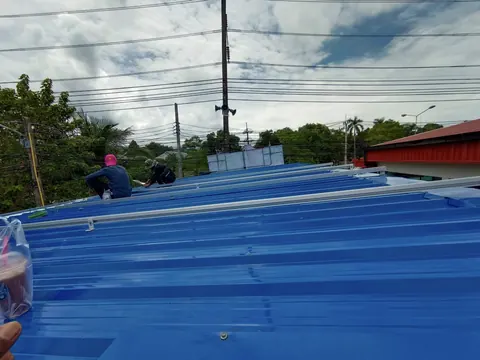
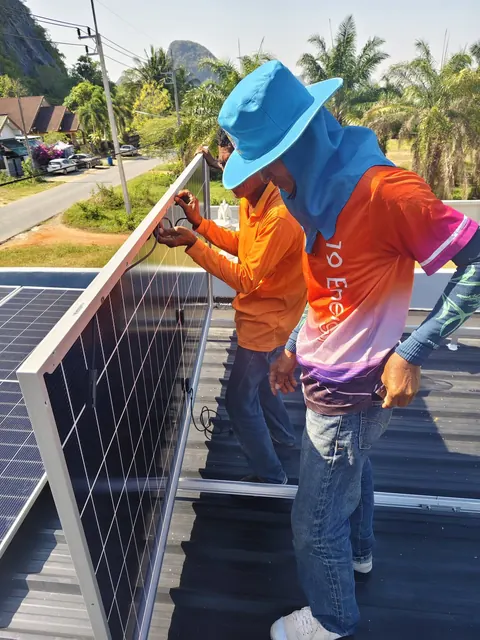
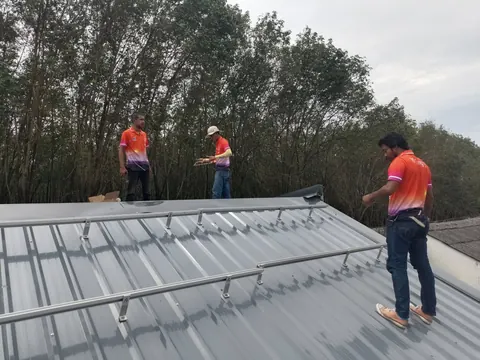
Our own team goes up on the roof — both to install and when we come back to look after the system. See all projects
Is your output dropping? We can check first
Open your inverter app, look at the generation history and send us a screenshot. We can tell you whether anything looks wrong before you decide whether a technician needs to go up and look.
Read before you decide
- How Often Should You Clean Solar Panels, and Why Is the South Different?Rain washes off dust, but not bird droppings or algae — and a small patch of grime cuts output more than a thin film of dust spread across the whole panel.
- Why Is My Solar Output Dropping, and Can I Check It Myself?Solar systems rarely die completely. More often they slowly produce less with no warning — and the way to catch it is to look at your generation history.
- Solar for Homes Near the Sea: What You Need to Know About Salt Air and CorrosionYou can install near the coast, with salt-resistant materials chosen at the design stage.