Solar for Pool Villas in Phuket, Koh Samui, Krabi & Khao Lak
Pool villas have loads an ordinary house does not: a pool filtration pump that runs every day and several air-conditioners working hardest in the afternoon. We design from your villa's real loads, use salt-resistant equipment, and add battery backup only when you need it.
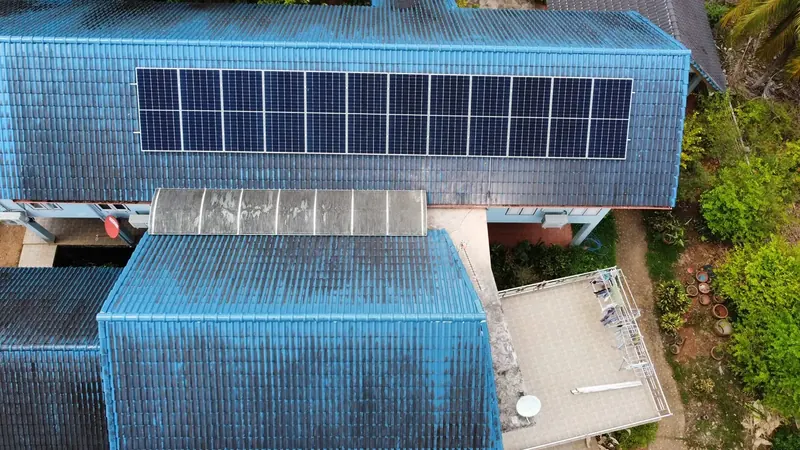
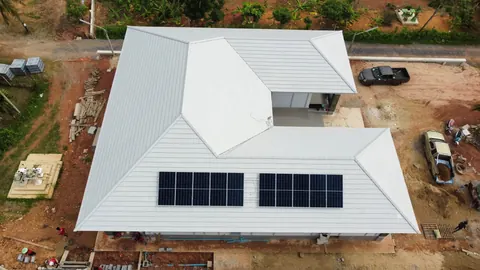
A house with a swimming pool, with solar panels on the roof.
Who it suits
Villa solar in Phuket, Koh Samui and Southern Thailand's resort areas
Private villas, short-let rental villas and holiday homes with a pool, in the areas where villas and accommodation are the main type of work.
Solar in Thalang
Phuket
Resorts and villas around Bang Tao and Choeng Thale — villas whose private pool filtration runs every day, even when no guests are staying.
Solar in Koh Samui
Surat Thani
Hotels, resorts and villas run air-con, water pumps and pool systems almost all the time, and hybrid systems with backup power are asked about more often here than on the mainland.
Solar in Takua Pa (Khao Lak)
Phang Nga
Khao Lak is home to the northern Andaman coast's upscale accommodation, which runs air-con, water pumps and pool systems all day.
Phuket Province — Hotels and villas are the main type of work across the province — Thalang, Kathu and Mueang Phuket.
Krabi Province — Resorts and accommodation where air-con, water pumps and pool systems run all day, especially on the coast.
Surat Thani Province — Koh Samui and Koh Pha Ngan, where island jobs have to be planned around shipping equipment by boat.
The same terms apply in every area: Site surveys are by appointment, and any travel charge is confirmed before booking. Own a villa as a foreigner? See solar for expats and foreign owners.
Loads vs. sunshine
Where a pool villa's power goes — and how well it matches the sun
A typical house uses most of its power in the evening and at night, so only part of the daytime solar output is used on site. A pool villa has a filtration pump that must run every day, and it can be scheduled for strong-sun hours.
When guests are in, several air-conditioners work hardest in the afternoon — exactly when the panels produce the most. Every unit you use yourself is worth the full grid price of around THB 4.20 per kWh.
Villas that use most of their power in the daytime therefore use more of their own solar than a typical home. Payback falls between the range for homes (6–10 years) and for daytime businesses (4–7 years), depending on how much of your villa's power is used in daylight.
Estimated at THB 4.20 per kWh and Southern Thailand sunshine (1,350 kWh per kWp per year, rainy season included). Actual payback depends on your bill and when you use electricity — we calculate it for your property before quoting. These payback figures are for systems without a battery.
Pool filtration pump
Runs every day on its filtration cycle, even when nobody is staying. It is a villa's base load, and the easiest one to schedule into strong-sun hours.
Several air-conditioners
The biggest load when guests are in, and heaviest in the afternoon — exactly when the panels generate the most.
Water pumps and water heating
Pressure pumps run with use, and electric storage water heaters can be set to heat and store water during the day.
Fridges, common lighting and security systems
Small loads that run 24 hours a day — usually the ones put on the backup circuit when a hybrid system is installed.
Villa-specific design
What makes a pool villa different from a house in town
Multi-plane roofs and large trees
Detached villas often have roofs with several planes and large trees in the garden, so the continuous area available for panels is much smaller than aerial photos suggest. We survey on site before sizing every system.
Concrete rooftops and waterproofing
On our Phuket pool villa, the frames sit on concrete footings resting on the roof deck. Where a rooftop has to be drilled, the waterproofing is checked first, and an engineer checks the structure can carry the load.
Salt air on the coast
Beachfront villas get aluminum mounting structures and stainless-steel fixings, the inverter is placed out of direct sea spray, and panels should be cleaned more often than in town because salt deposits stick harder than ordinary dust.
Where the equipment goes
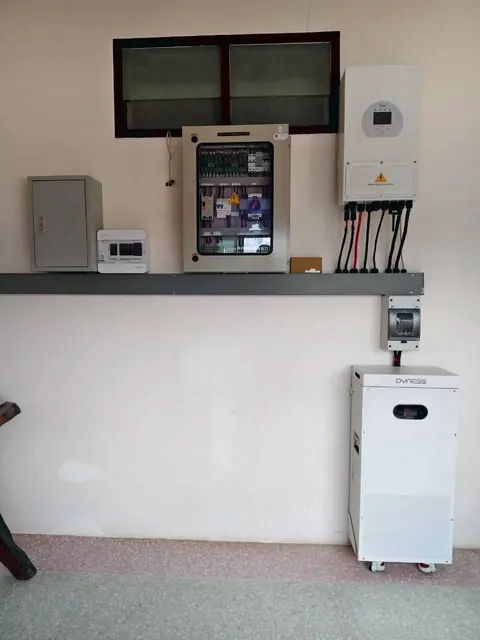
The inverter, batteries and control panel belong in an electrical room or a shaded, ventilated spot close to the main board — as on the Phuket job, where everything sits next to the building's main distribution board.
Island jobs
Every piece of equipment has to cross by boat, so any on-site fix that needs extra parts takes longer. On Koh Samui and Koh Pha Ngan we survey in more detail than usual before ordering.
Choosing the backup circuits
A hybrid system does not have to back up the whole house. Putting only the circuits you need during a power cut — fridges, lights, internet, water pumps — on backup lets the battery last far longer than trying to run every air-conditioner.
A hybrid system with batteries suits villas that need backup power during outages. It does not make the system pay back faster, because batteries add a lot to the investment. If the only goal is a lower bill, an on-grid system gives a better return per baht. Read about hybrid systems and batteries
Delivered projects
15 kW hybrid systems in Phuket and on Koh Samui
Hybrid systems with batteries that our team has installed and handed over. Open each one for the site photos and equipment.
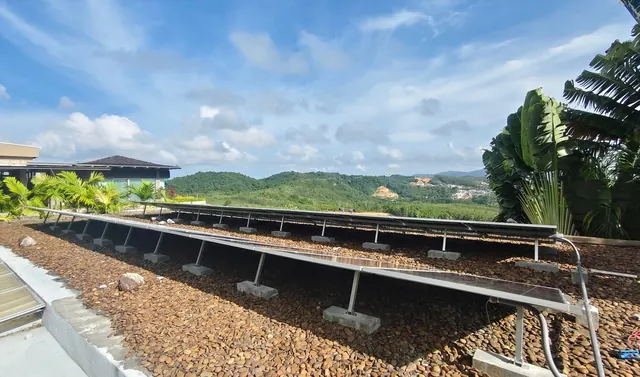
Pool villa, Phuket Province · 15.48 kW
15.48 kW Hybrid Solar System at a Pool Villa in Phuket
15.48 kW hybrid solar with Solis batteries for a pool villa in Phuket — panels on concrete-footed rooftop frames, so solar power is usable day and night.
- Solis inverter
- Two Solis Storage battery cabinets
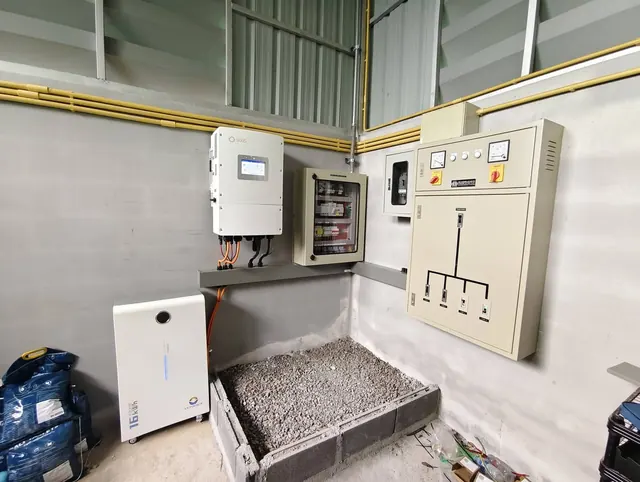
Koh Samui, Surat Thani Province · 15 kW
15 kW Hybrid Solar System on Koh Samui
A 15 kW three-phase hybrid solar system with battery backup on Koh Samui. See the equipment used and how the control panels were laid out on site.
- Solis 15 kW inverter
- LVTopsun 314Ah battery, labeled capacity about 16.08 kWh
System sizes
Sizes pool villas often choose
We don't publish prices, because the real price depends on the roof, the structure, cable runs and whether you add a battery. You get a quote after the site survey.
10 kW
single-phase or three-phase · 16 panels
Large homes, pool villas, shops and daytime businesses
- Output per year
- ~13,500 kWh
- Panel area
- ~45 m²
15 kW
three-phase · 24 panels
Small factories, hotels and commercial buildings
- Output per year
- ~20,250 kWh
- Panel area
- ~68 m²
20 kW
three-phase · 32 panels
Factories, cold storage and buildings with heavy all-day loads
- Output per year
- ~27,000 kWh
- Panel area
- ~90 m²
Output is estimated from Southern Thailand sunshine of 1,350 kWh per kWp per year, rainy season included. Actual output depends on roof direction, pitch and tree shade. Smaller single-phase villas can start at 5 kW; 15 kW and above needs a three-phase supply.
Equipment and warranty
Named brands you can check, and a warranty for each component
Equipment we use
- Solar panels
- JA Solar, LONGi or Jinko Solar · N-type TOPCon, dual-glass, 620–630 W per panel
- Inverters
- HUAWEI, Solis or Deye · On-grid and hybrid inverters with a monitoring app so you can check your generation history yourself
- Batteries (hybrid systems)
- LVTopsun or Sunwoda · LiFePO4 lithium batteries for hybrid systems, sized to your night-time consumption
The exact brand and model are written into your quote before you sign anything.
Warranty by component
Solar panels — product warranty
Set by each panel manufacturer for the brand and model you choose, stated in your quote
Solar panels — power output warranty
Set by each panel manufacturer for the brand and model you choose, stated in your quote
Inverter
Most major brands give 10 years, and it can be extended
Installation and mounting work by 19Energy
2 years · 19Energy's own technicians handle every job
Aftercare for the first 2 years
- Panel cleaning once a year
- Annual system health check
- A check of your building's wiring while we are there
Included in the installation price. We schedule each visit and contact you 14 days ahead. Beachfront villas should clean more often than this — see panel cleaning.
Getting started
An estimate from your bill first, then a site survey
A first estimate from your electricity bill is free — just send a photo of the bill on LINE.Send your villa's location too. When you want a quote you can rely on, we book a site survey.
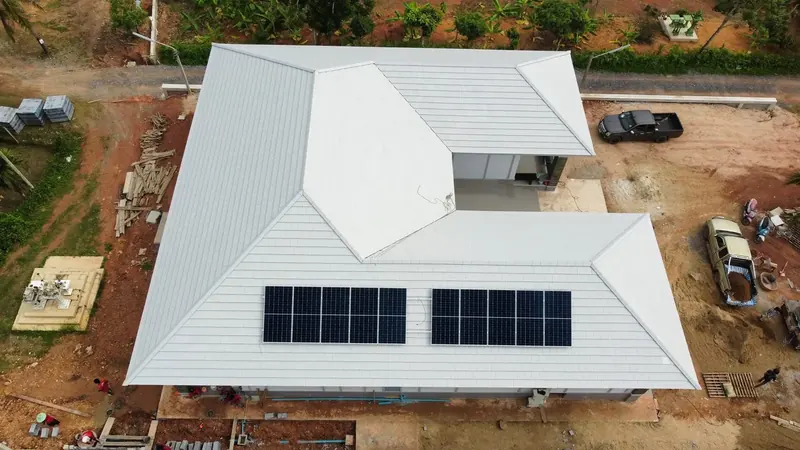
Site survey fee THB 1,200–1,500
For sites within 100 km, refunded in full against your quote when you go ahead with the installation.
Why there is a fee
It covers fuel, a technician's full day away from installation work, and the time to measure, calculate and write up your report.
Site surveys by appointment
Any travel charge is confirmed before booking
FAQ
What villa owners ask us most
Our villa is rented out and sometimes empty for days. Will the solar power go to waste?
We size the system from the loads that run every day whether or not guests are in — pool filtration, fridges and common lighting — then add a conservative allowance for the part that rises and falls with bookings. On empty days the power generated still goes into those base loads. We ask for 12 months of electricity bills so we can see the real difference between busy and quiet periods.
Can a villa sell surplus power back to the grid?
It depends on the villa's meter type. The rooftop solar buy-back scheme is open only to residential meters, so villas on a commercial meter do not qualify and need equipment that prevents power flowing back into the grid, as the Provincial Electricity Authority (PEA) requires. Even where a villa qualifies, the buy-back rate is far below what you pay for grid power, so the systems that pay off are designed mainly for on-site use. We check the meter type during the survey.
Do we need a battery?
Not necessarily. If the goal is to cut the bill, an on-grid system without a battery gives a better return per baht. A battery suits villas that need backup power during outages, which is a common request on the islands. But it adds a lot to the investment, so decide on it for backup power, not for payback.
The villa is right by the sea. Will salt air corrode the system?
It can be installed, but the materials have to be chosen at the design stage. For coastal sites we use aluminum mounting structures and stainless-steel fixings, keep the inverter out of direct sea spray, and recommend cleaning the panels more often than usual, because salt deposits block light and stick harder than ordinary dust.
Do we have to stop taking guests during installation?
Most roof work can be done without closing the villa. Power only needs to be off while we connect to the main board and while the PEA changes the meter — about half a day. We give you the schedule in advance so you can pick a day with no booking.
Our roof has several planes. Can we still install?
Yes, but the usable area is usually smaller than it looks from the air, because each plane faces a different direction and trees cast shade. That is why we survey on site before sizing every system. If the roof is not enough, a rooftop terrace, carport roof or service building can be used instead.
The owner lives abroad. Can we still arrange the work?
Yes. Our team replies in English — on LINE, by email or by phone. Sending a photo of your electricity bill and your location on LINE is the quickest way to get an estimate. The on-site survey can be booked in advance with your villa manager, and after installation you can check the generation history yourself in the inverter's app from anywhere.
Get a solar quote for your villa
Send 12 months of electricity bills and tell us whether you need backup power. We will put an on-grid option and a hybrid option side by side, with assumptions you can check.
Our team replies in English — on LINE, by email or by phone. Sending a photo of your electricity bill and your location on LINE is the quickest way to get an estimate.
Examples of homes and holiday homes we have installed See all projects
Read before you decide
- Power Cuts on Koh Samui and Koh Pha Ngan: What Solar Can and Can't DoKoh Samui's power comes through undersea cables from Khanom on the mainland, and Koh Pha Ngan shares the same outages. A standard solar system goes dark with the grid every time — backup has to be designed in from the start.
- Is Solar With a Battery Worth It in Areas With Frequent Power Cuts?A battery doesn't always save you more on electricity. What it really buys you is peace of mind during power cuts — and you have to judge whether that is worth the price.
- Solar for Homes Near the Sea: What You Need to Know About Salt Air and CorrosionYou can install near the coast, with salt-resistant materials chosen at the design stage.