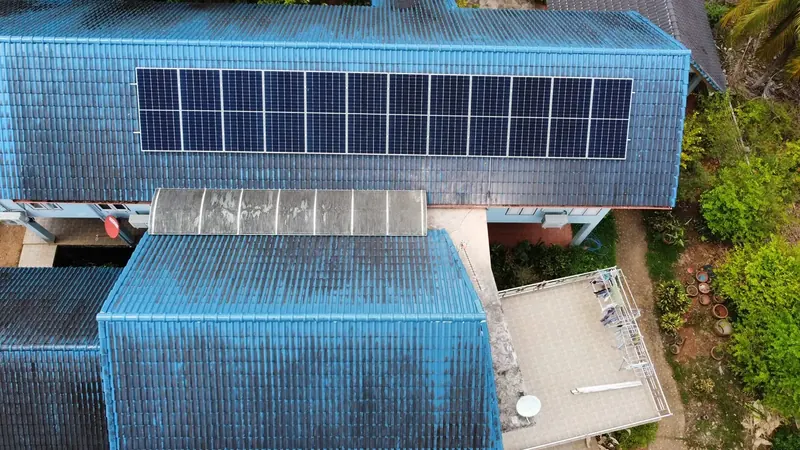
Most people start thinking about solar from their electricity bill. But what decides whether the job holds up or causes trouble a few years later is usually the roof under the panels. A roof that already leaks, a structure that's rotting, or waterproofing that has failed won't go away because panels sit on top — it gets harder to fix, because the panels have to come down first. This article covers what to look at, which roofs should be repaired first, and what you can check yourself before a technician visits.
Why check the roof before installing, not after
The power output warranty on solar panels set by each panel manufacturer for the brand and model you choose, stated in your quote, so a system is designed to stay on the roof for twenty-plus years. The US Department of Energy likewise advises considering the age of your roof, and how long until it needs replacing, when planning solar.
If the roof needs replacing within a few years, the job becomes: take the panels down, replace the roof, reinstall the panels. That costs more than repairing or replacing the roof first. And if panels go over an existing leak, when water comes in later it's hard to tell whether the new mounts or the old condition is to blame.
Metal sheet roofs: rust and old screw holes
The metal sheet doesn't carry the panels' weight — the steel purlins beneath it do, and every mounting point must go into a purlin. So you need to check both the sheet and the frame under it.
- Rust around existing screw holes. If the steel around the hole has corroded, adding new fixings to that sheet will leak however well it's sealed. The sheet must be repaired or replaced first.
- Lines of rust along the valleys of the corrugation or at the eaves, usually where water pools or runs for long periods.
- Water stains or discoloration on the ceiling below, which mean there's already a leak.
- The profile type — standard corrugated, trapezoidal or clip-lock standing seam — each needs a different mounting kit. Clip-lock seams can be clamped without drilling at all.
- Older wide-span buildings such as warehouses and factories were often designed only for the original roof load and need an engineer's calculation first.
Homes near the sea need a closer look for rust, because salt air speeds up corrosion. See our article on solar near the sea for details.
Tile roofs: cracked, brittle tiles and the timber frame
On a tile roof, nothing is fixed to the tiles themselves. Hooks are fixed to the rafters or battens beneath, so the main concerns are broken tiles and the strength of the roof frame.
- Cracked, broken or slipped tiles should be replaced before installation.
- Tiles that have become brittle after years of sun and rain break easily when technicians work on the roof, even with load-spreading boards.
- Discontinued tile models can't be matched if one breaks, so spare tiles should be sourced before work starts.
- Old timber rafters or battens with rot or termite damage may not have enough strength left to hold screws and must be reinforced or replaced first.
- Water stains on the ceiling or on timbers under the roof mean water is already getting in.
Concrete roof decks: the existing waterproofing
A flat concrete roof lets you choose the panels' direction and tilt freely, but always check the existing waterproofing first. If panels go on top of waterproofing that has already failed, you won't be able to tell later whether a leak comes from the mounts or from the old membrane.
- Hairline cracking across the surface of the deck.
- Waterproofing membrane that has blistered or is peeling in places.
- Water stains or damp patches on the ceiling of the floor below.
- Puddles that remain after rain stops, meaning the drainage slope isn't working — bases or ballast blocks placed across the water's path make this worse.
- How much weight the building can carry, since ballasted (non-drilled) mounting adds several times more weight to the deck than drilled mounting.
The extra weight the roof has to carry
Panels and mounting weigh roughly 12 to 15 kilograms per square meter. A typical house roof frame in good condition can carry that, but that no longer holds if the frame is rotten, the timber has termites, or it's an older wide-span building that never allowed for extra load. This has to be checked from under the roof as well as on top, and it can't be judged from photos.
If the structure needs reinforcing, the cost depends on the actual condition found during the survey, and we tell you after the survey, before any work starts. If we find a problem during installation that couldn't be seen at the survey, such as a rotten purlin hidden under the tiles, we stop and let you know before going further.
Roof life vs panel life
| Roof condition | What to do |
|---|---|
| New or recently replaced, no leaks | Install as planned |
| Several years old, a few isolated defects | Repair those spots, then install |
| Rust around many screw holes, brittle tiles throughout, or widespread waterproofing failure | Replace the roof or redo the waterproofing first |
| Roof replacement or renovation already planned | Do the roof first, then install solar |
Check for shade at the same time
A sound roof that's heavily shaded still generates less than it should. The US Department of Energy notes that if trees near your home shade the roof excessively, rooftop panels may not be the best option.
- Trees near the house, including ones still growing, such as coconut palms or large trees along the fence line.
- Taller neighboring buildings, especially in shophouse rows.
- Water tanks, lift machine rooms, vent stacks or parapet walls on a roof deck.
- Utility poles or antennas that cast a strip of shadow.
A strip of shade across panels wired in series costs far more output than the shaded area alone would suggest. Seeing where shadows fall in the morning and afternoon is part of choosing where the panels go.
What our technicians check during the site survey
The on-site survey costs THB 1,200–1,500, refunded in full against your quote when you go ahead with the installation. At the site, the technician covers:
- Measuring the actual roof and the installation area
- Checking the condition of the roof structure — something photos can't show. On tile roofs we also check from underneath.
- Checking sun direction and any shading
- Deciding where the equipment will be mounted
- A survey report with photos of your actual roof
- Generation and payback calculations based on your own electricity bill
If the roof needs repair first, we tell you at the survey, so the work can be done before installation.
Check it yourself first, and what photos to send on LINE
Before booking a survey, you can check a lot without going up on the roof — and we don't recommend climbing up yourself, especially on tiles that break easily or metal sheet that's slippery when wet. Look from the ground, from an upstairs window, and from the ceiling hatch if there is one.
- A wide shot of the roof showing the whole surface and which way it faces
- Close-ups of any rust, broken tiles or blistered waterproofing
- Photos of ceilings with water stains, and which room they're in
- A photo of the roof space from the ceiling hatch, if you can open it safely
- Photos of trees or buildings around the house that might shade the roof
- A photo of your consumer unit (breaker panel) and meter
- Your latest electricity bill
- Roughly how old the roof is, and when it was last repaired or replaced
A first estimate from your electricity bill is free — just send a photo of the bill on LINE. Roof photos give us an early picture and help us prepare the right equipment, but the actual condition of the structure still has to be checked on site.
Photos help screen for problems, but they can't settle structural questions. Rotten purlins, termites in the rafters or waterproofing that has failed from the inside usually don't show up in a photo.
Sources used for this article
Figures in this article are based on public announcements and news reports (most sources are in Thai). If the conditions change, the latest official announcement from the relevant authority applies.
Frequently asked questions
How old does a roof have to be before I should replace it first?
There's no single number that fits every roof — it depends on the roof type, its actual condition and the location; homes near the sea, for example, deteriorate faster. Go by condition rather than age. If there's rust around many screw holes, brittle tiles throughout, or widespread waterproofing failure, replace or redo it first, because the panels will be up there for twenty-plus years.
My roof leaks a little. Can I put panels over it for now?
It's better not to. Repair the leak first. Once panels are on top, it's harder to repair, and if it leaks later you can't tell whether the new mounts or the old condition is responsible.
If I send roof photos on LINE, can you tell me what needs fixing?
Photos give an early picture — rust, broken tiles, water stains — but the condition of the structure can't be judged from photos. It has to be checked on site, including from under the roof.
If the survey finds the structure needs reinforcing, is that included in the installation price?
Roof reinforcement isn't included in the standard installation price, because the cost depends on the actual condition. We let you know after the survey, before work starts.
Which roof type is easiest for solar?
Metal sheet in good condition is the quickest and simplest, especially clip-lock standing seam, which can be clamped without drilling. Standard corrugated fiber-cement tiles are also straightforward, while concrete tiles and concrete roof decks take more time and equipment.
Related services and areas
Keep reading
- Will Solar Panels Make My Roof Leak? Installation Methods That Protect Your RoofIt is homeowners' number-one worry, and a reasonable one: drill points that are not sealed correctly really can cause leaks.
- Solar for Homes Near the Sea: What You Need to Know About Salt Air and CorrosionYou can install near the coast, with salt-resistant materials chosen at the design stage.
- How Long Does Solar Installation Take, From Signing to Switching On?The installation itself takes only a few days, but the paperwork with the utility takes months. Many people assume the system can be used as soon as it's installed.
- 7 Things to Check Before Choosing a Solar Installer in Southern ThailandThe cheapest price is not necessarily the best value, and the most expensive is not necessarily the best. Here is what to look at instead.