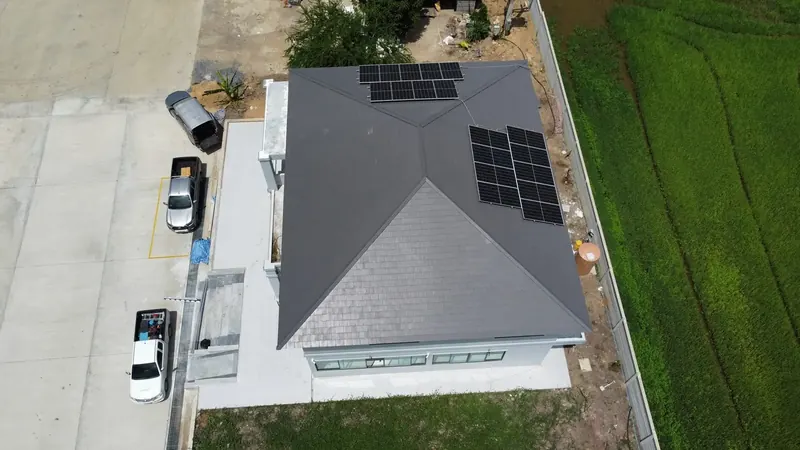
This is what homeowners worry about most — even more than price — and it is a fair concern, because drill points that are not waterproofed correctly really can make a roof leak.
The risk is real if the installation is done incorrectly, and almost nil if it is done correctly. This article explains what correct and incorrect look like, so you can check the work yourself.
Where the risk points are
Most rooftop solar installations have to fix the mounting structure to the roof purlins or rafters, which means drilling. Those drill points are where all the risk lies.
A 5 kW system has roughly 16 to 24 fixing points. Every one of them must be waterproofed correctly — getting just one wrong can cause a leak.
Each roof type needs a different method
Metal sheet roofs
The easiest and lowest-risk type, because fixings go through the top of the ribs, where water does not collect. The screws must have built-in rubber washers and be tightened to the correct torque. Over-tighten them and the washer cracks, becoming a leak point within a few years.
Some metal sheet profiles can use clamp-on fixings that need no drilling at all — the best option if the rib shape allows it.
Corrugated fiber-cement tile roofs
These use hooks fixed directly to the purlins that come up through the gap between tiles. This method does not drill through the tile itself, so it is safer than drilling through.
The thing to watch is that the tile the hook passes under may need to be ground down slightly so the hook does not push the tile up. A tile that lifts even a little lets rain blow back in when it is driven by the wind.
Concrete tile roofs (such as CPAC)
The hardest of the three, because the tiles are thick and brittle and crack easily when stepped on. They need specialized hooks and experienced installers. This type of job takes significantly more time and labor than metal sheet.
Concrete flat roofs
The safest option is a ballasted base that does not drill into the slab at all, but the weight and wind loads must be calculated carefully. If drilling is unavoidable, the roof's waterproofing must be fully restored at every point — careful work, because a leaking flat roof is much harder to fix than a pitched one.
Questions to ask the installer before signing
- What kind of mounting hardware do you use for my type of roof? Can I see photos or a sample?
- How many drill points will there be in total, and what will you seal them with?
- If the roof leaks from a point you drilled, will you take responsibility, and for how many years?
- Can you write your responsibility for leaks clearly into the contract?
- Will you inspect the purlins and rafters before installing? If you find rot, will you tell me first or carry on?
Question four matters most. Having the installation warranty in writing makes the terms clear for everyone, and it is worth checking that it covers leaks as well as the equipment.
Points to clarify before installation
- Will the roof be surveyed in person before the quote is prepared, so the condition of the roof is known from the start?
- Which mounting hardware will be used for your roof type?
- How will the drill points be sealed? Purpose-designed mounting hardware lasts far longer than silicone alone, which degrades within a few years in our climate.
- Does the quote list the work included, including the mounting hardware and working time?
- Is the leak warranty written into the contract?
What if your roof is already old?
If the roof is close to needing replacement, replace it before installing solar. Taking the panels down to replace the roof and then putting them back is a cost you can avoid with good planning.
Panels stay on the roof for twenty-plus years, so it makes sense to start with a roof that will last as long as they do. We check the condition of the roof during the site survey, and if we find it should be replaced first, we will tell you.
Frequently asked questions
Does the installation warranty cover roof leaks?
Ours does. If a leak comes from a point we drilled, it is our responsibility under our 2-year installation warranty. Leaks from other points unrelated to our work, or from existing deterioration of the roof, fall outside the terms — in that case we inspect and show you the cause first.
Can the roof still be repaired after the panels are installed?
Yes, but it becomes harder in the areas covered by panels. That is why our designs leave walkways and edge clearances, so there is always room to reach the roof.
Related services and areas
Keep reading
- 7 Things to Check Before Choosing a Solar Installer in Southern ThailandThe cheapest price is not necessarily the best value, and the most expensive is not necessarily the best. Here is what to look at instead.
- Solar for Homes Near the Sea: What You Need to Know About Salt Air and CorrosionYou can install near the coast, with salt-resistant materials chosen at the design stage.
- JA Solar, LONGi, Trina, Jinko, Canadian: How Do Solar Panel Brands Compare?What you can actually compare between panel brands is the price per watt and the number of years in the warranty document — this article puts both side by side for five brands.
- Single-Phase vs Three-Phase Power: Do You Need a New Meter for Solar?Your home's power supply sets how big a solar system you can install — and it's worth knowing early whether you need a new meter, which is a separate cost.