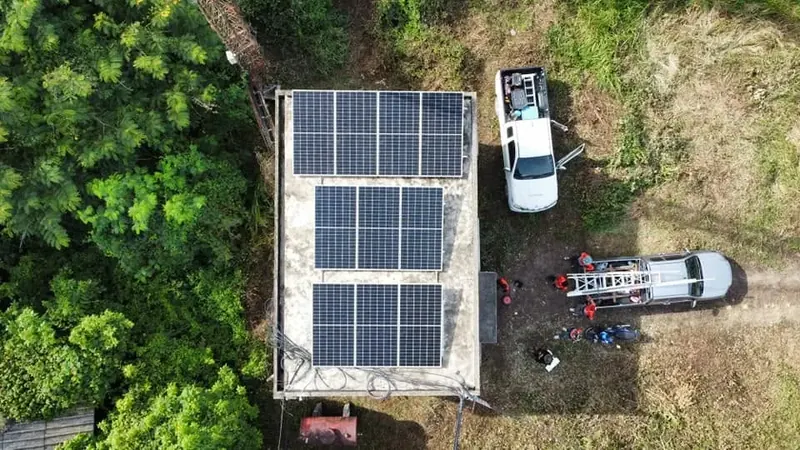
Southern Thailand has coastline on both sides — the Gulf of Thailand and the Andaman Sea — so a large number of homes and businesses are within reach of salt air. It is a condition that designs made for inland areas do not account for.
What salt air does to a solar system
Sea spray carried by the wind deposits chloride on metal surfaces. Chloride speeds up corrosion many times over. Metal that would last ten years in town can show signs of corrosion within two to three years on the coast.
The part most affected is not the panel itself — the front is glass and the frame is aluminum, which both hold up well. It is the metal components around it.
- Fixing screws and bolts. If ordinary plated steel is used, they rust and loosen, which is dangerous because panels could come off in strong wind.
- Hooks and brackets exposed to both salt air and rain.
- Control boxes and equipment enclosures. If the seals are not good enough, salt can get in and settle on the terminals inside.
- Cable connectors, where chloride increases resistance and causes heat to build up.
How close to the sea do you need to worry?
There is no fixed line, because it also depends on the prevailing wind direction and what lies between you and the sea. Of two houses the same distance from the water, the one facing straight into the sea breeze is hit harder than one sheltered by a hill or a line of trees.
A more practical way to judge than measuring distance is to look at what is already around the house. If steel fences, railings or outdoor air-con units rust faster than normal, that is the sign the area needs coastal-grade materials.
Materials to use
| Component | Use in coastal areas | Avoid |
|---|---|---|
| Panel mounting rails | Aluminum | Ordinary galvanized steel |
| Screws, bolts, clamps | Stainless steel | Plated steel |
| Control boxes and enclosures | High water- and dust-protection rating, mounted in the shade | Standard boxes mounted in the open |
| Inverter location | Under cover, well ventilated, out of sea spray | An exterior wall facing the sea wind |
A point people overlook is direct contact between different metals, such as steel screws on aluminum rails. This causes galvanic corrosion, which is much faster than normal corrosion. Using stainless steel throughout is therefore not just about resisting rust — it is also about the materials being compatible with each other.
Maintenance that differs from inland properties
Coastal homes should clean their panels more often, because salt deposits, unlike dust, are not fully washed away by rain. When they dry they leave a white residue that blocks light and bonds more firmly over time.
Cleaning should be a thorough rinse with fresh water, not just a wipe, and the fixing points and screws should be checked in the same visit. Spotting rust when it first appears is much easier to deal with than waiting until things loosen.
Monsoon winds need to be considered at the same time
Coastal areas in the South face not only salt air but also periodic strong monsoon winds. The structure therefore has to be designed for the actual wind load at that location, not with the same standard design used inland.
In practice this means more fixing points, larger clearances from the roof edge, and not tilting panels above the roof pitch unnecessarily, because raised panels catch far more wind.
Frequently asked questions
Does installation cost more in coastal areas?
Yes. Stainless-steel hardware and a structure designed for wind loads cost more than standard components. The difference is still better value than having to replace the mounting hardware in a few years, which also means paying to remove and reinstall the panels.
Does the panel warranty cover salt corrosion?
Most panel manufacturers state environmental conditions of use in their warranty documents, and many do not cover damage from severely corrosive environments. Read the terms carefully before deciding, and choose corrosion-resistant mounting materials from the start rather than relying on the warranty.
Related services and areas
Keep reading
- It Rains a Lot in Southern Thailand — Does Solar Still Produce Real Power?Solar panels run on light, not heat, so they still generate on overcast days. But how much less do they produce, and is it still worth it?
- Will Solar Panels Make My Roof Leak? Installation Methods That Protect Your RoofIt is homeowners' number-one worry, and a reasonable one: drill points that are not sealed correctly really can cause leaks.
- JA Solar, LONGi, Trina, Jinko, Canadian: How Do Solar Panel Brands Compare?What you can actually compare between panel brands is the price per watt and the number of years in the warranty document — this article puts both side by side for five brands.
- Why Is My Solar Output Dropping, and Can I Check It Myself?Solar systems rarely die completely. More often they slowly produce less with no warning — and the way to catch it is to look at your generation history.