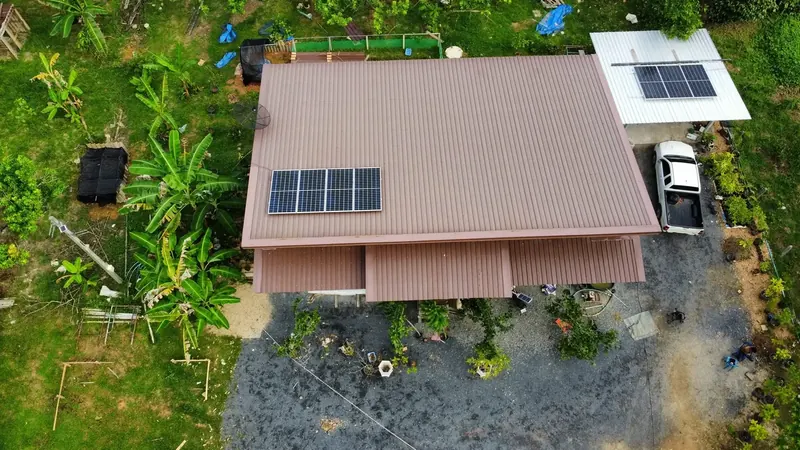
The Thai Cabinet approved a measure that lets people who install rooftop solar on their home deduct the cost from their Thai personal income tax — the actual amount paid, up to THB 200,000. It was issued as Royal Decree No. 805 of 2026 (B.E. 2569) under the Revenue Code, which is administered by the Revenue Department, Thailand's tax authority.
The measure covers expenses incurred between 3 March 2026 and 31 December 2028. It does not apply retroactively to systems installed before that period.
How much you can really deduct
THB 200,000 is the amount you subtract from your taxable income — it is not money you get back. What you actually save depends on your personal income tax bracket.
| Tax bracket | Deduction | Actual tax saved |
|---|---|---|
| 5% | THB 200,000 | THB 10,000 |
| 10% | THB 200,000 | THB 20,000 |
| 20% | THB 200,000 | THB 40,000 |
| 30% | THB 200,000 | THB 60,000 |
If you do not pay Thai personal income tax, this measure does nothing for you, because there is no tax to deduct from. This applies to anyone whose income is not taxed in Thailand — check your own position with your accountant before counting on it.
The conditions that disqualify many people
The system must be 10 kW or smaller
For individuals, the total panel capacity must not exceed 10 kilowatts. This directly affects how you size your system. If you are weighing 10 kW against 15 kW, factor the deduction into the decision, because a 15 kW system or larger does not meet the condition for individuals.
It must be an on-grid system that has been successfully connected
The system must already be connected to the grid of either the Metropolitan Electricity Authority (MEA, Bangkok area) or the Provincial Electricity Authority (PEA, the state utility for the rest of the country, including the South). Off-grid systems that are not connected to the utility at all do not qualify. The deduction is claimed in the tax year in which the grid connection is completed — not the year you paid.
The name on every document must match
This is the most common mistake. The taxpayer, the registered owner of the electricity meter, the person who applied to the utility for grid connection, and the name on the tax invoice must all be the same person. If the house is in the parents' name but the son or daughter paid and files the tax return, the deduction cannot be used.
It must be your own home, and each person can claim for one system
Rented homes do not qualify, and one person can claim the deduction for one system only.
You need an electronic tax invoice
The supporting document must be an electronic tax invoice (e-Tax Invoice) issued through the Revenue Department's system. Traditional paper tax invoices are not accepted. Confirm this with your installer before you sign.
If you install under a company or business
Companies and people with business income use a different condition: they can deduct 1.5 times the equipment cost as an expense. Only the equipment counts — installation labor is not included.
- The equipment must be new and never used before
- The equipment must carry the No. 5 energy-efficiency label as specified by the authorities
- It cannot be combined with other investment-promotion incentives
Businesses that use most of their electricity in the daytime therefore benefit twice — from lower electricity bills and from the tax benefit — which together shorten the payback period compared with a calculation based on electricity savings alone.
Should you rush to install because of this measure?
The measure runs until the end of 2028, which leaves a reasonable amount of time, so this is not a decision you need to make this week. You can take the time you need to compare options before signing.
But if you already plan to install and you already pay Thai personal income tax, installing while the measure is in force is clearly better than waiting until after 2028. Allow time for the permit process with the utility too, because the deduction arises in the tax year the connection is completed, not the year you pay.
What to ask your installer before signing
- Can you issue an electronic tax invoice through the Revenue Department's system?
- Is the quoted price before or after VAT, and what amount can be claimed as a deduction?
- What is the total capacity of the proposed system in kilowatts, and is it over 10 kW?
- Will you handle the grid-connection application with the utility, and in which tax year do you expect it to be completed?
- Whose name will the tax invoice be issued in, and does it match the name of the meter owner?
Sources used for this article
Figures in this article are based on public announcements and news reports (most sources are in Thai). If the conditions change, the latest official announcement from the relevant authority applies.
Frequently asked questions
I installed last year. Can I claim retroactively?
No. The measure applies to expenses incurred from 3 March 2026 onward. It has no retroactive effect for systems installed and paid for before that date.
Can I claim the deduction for a 15 kW system?
For individuals, the condition limits total capacity to 10 kW, so a larger system does not qualify. If you need a bigger system because you genuinely use a lot of power, weigh the deduction against the extra electricity savings — we can calculate the comparison for you before you decide.
The house is in my father's name, but I pay and file the taxes. Can I claim?
Under the conditions, the taxpayer, the meter owner, the person applying for grid connection and the name on the tax invoice must all be the same. This case is therefore a problem. Consult your accountant or the local Revenue Department office before deciding, because it depends on the specific situation.
Does a THB 200,000 deduction mean I get THB 200,000 back?
No. THB 200,000 is subtracted from your income before tax is calculated. What you actually save is 200,000 multiplied by your tax rate — at a 10% bracket, for example, you save THB 20,000.
Can I use this together with selling power back under the residential solar (Solar Phak Prachachon) program?
They are separate things. The residential solar program is about selling surplus electricity back to the utility, while this measure is a tax benefit, so in principle they do not conflict. The rule against double benefits relates more to investment-promotion schemes such as BOI incentives. Confirm your own case with your accountant.
Related services and areas
Keep reading
- Monthly Bill of THB 3,000, 5,000 or 10,000 — What Size Solar System Do You Need?The best-value size is not the largest your roof can hold — it is the size that matches the electricity you use during the day.
- Thailand's 2026 People's Solar Program: Selling Power Back at THB 2.20 — Is It Worth It?The program is real and so are the terms, but the THB 2.20 the state pays is almost half what you pay for power yourself. Here's how much selling back actually earns — and why it isn't the main reason to install solar.
- Can You Pay for Solar in Installments? Financing Options Worth KnowingYou can pay in installments. Work out how much of your savings goes to interest, so you know the full cost in advance.