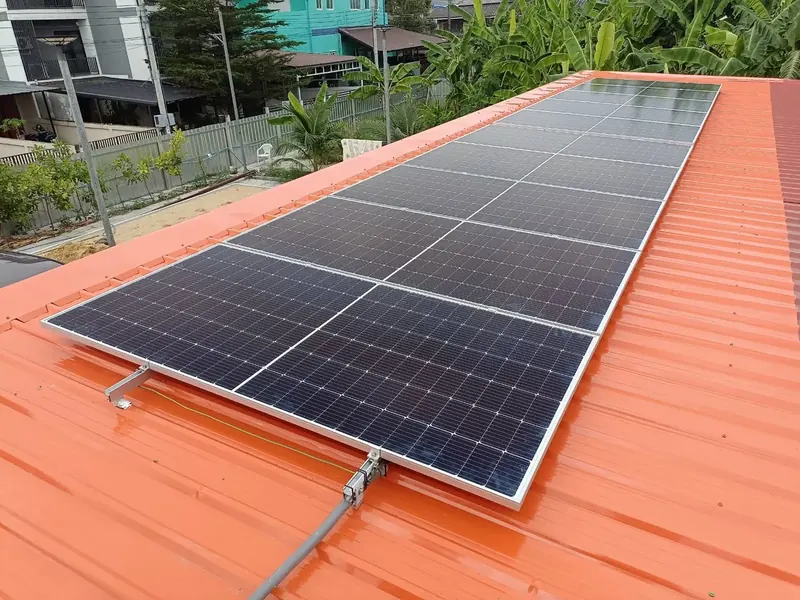
People who live with frequent power cuts, especially on the islands, at resorts or on farms at the end of a long rural line, tend to ask the same question: should I install solar or buy a generator? The two don't really compete head to head, because they do different jobs. This article sets out what each one does in an outage, where the running costs come from, and when using both beats choosing one.
What each option does when the grid goes down
A generator is an engine that turns an alternator, running on gasoline, diesel or gas. As long as it has fuel and keeps running, it supplies power day and night, rain or shine. That is its clearest strength.
On-grid solar, the most common type, stops supplying power the instant grid power is lost, however bright the sun. This anti-islanding protection is required on every certified grid-tied inverter, so the system can't push power back into a line that utility crews are repairing. On-grid solar lowers your bill, but it does nothing for power cuts.
For solar to supply power during an outage, you need a hybrid system with batteries and a circuit that isolates the house from the grid first. In the daytime the panels help run the load and charge the batteries; at night or through days of heavy cloud, you only have what's left in the batteries.
| Generator | On-grid solar | Hybrid with batteries | |
|---|---|---|---|
| Power during an outage? | Yes, as long as there's fuel | No — shuts off automatically | Yes, on the circuits designed for backup |
| Lowers the monthly bill? | No — only used in outages | Yes, every sunny day | Yes, and it provides backup |
| Outage at night | Runs normally | No power | Runs as long as the batteries last |
| Outage lasting several days | Yes, if you can refuel and maintain it | No power | Depends on battery size and the next day's sun |
| Noise and exhaust | Both | None | None |
Running costs: fuel vs sunlight
The two have opposite cost structures. A generator costs money every time it runs: fuel, plus engine oil and parts that wear with running hours. The longer you run it, the more you pay, and fuel costs rise and fall with oil prices you can't control.
Solar is a large upfront cost; after that, sunlight is free. What remains is panel cleaning and routine checks. A solar system earns its keep from the hours it generates, not from the number of outages.
In practice, a generator suits occasional use. Run it as your main source every day and fuel costs pile up quickly. Solar suits generating every day to cut your bill — it isn't something you buy only to wait for a blackout.
Batteries do not make a solar system pay back faster. Adding them raises the cost and always lengthens the payback period of the whole system. What they give you is power during outages, so decide based on the damage outages actually cause you, not on payback figures.
Noise, exhaust and maintenance
A generator is an engine, so it brings noise, vibration and exhaust. At your own home that may be acceptable, but at a rental villa or resort, an engine running in the middle of the night is something guests notice straight away. Where you place it has to account for both noise and safety.
A generator needs maintenance following the manufacturer's manual: engine oil, filters, the starter battery and regular test runs. A unit left sitting for months without ever being started is prone to trouble on the day the power actually goes out.
Solar has no moving parts. The main upkeep is cleaning the panels and checking cable connections, and the batteries in a hybrid system have a battery management system that controls charging on its own — there's nothing to top up.
A generator can't run forever
One point to plan for: a generator only runs as long as its fuel lasts. A multi-day outage means keeping enough fuel in reserve and having someone to refuel. On an island, or where roads are flooded, getting more fuel can be harder than usual at exactly the time the power is out.
Refueling has its own procedure. The US Occupational Safety and Health Administration (OSHA) notes that generators get hot while running and stay hot long after they stop, and that fuel spilled on hot engine parts can ignite. Before refueling, shut the generator down and let it cool. Running for several days straight therefore still means breaks with no power.
OSHA also advises storing fuel in approved containers designed for it, away from the generator and other heat sources, and not inside your home or near living areas.
Safety: never backfeed the grid
This is the most important section. OSHA states that a generator must never be connected directly to a building's electrical system unless a qualified electrician has properly installed it with a transfer switch. Connecting directly without one can energize wiring for great distances and puts utility workers and others nearby at risk of electrocution.
- A transfer switch lets the house take power from one source at a time — the grid or the generator, never both. That stops power flowing back into the line, and stops grid power colliding with the generator when it comes back.
- Never plug a generator back into a wall socket in the house, because that feeds power back into the grid.
- If the house already has on-grid solar, the inverter may treat generator power as grid power and start feeding into it, which ordinary generators aren't designed to accept. The two systems have to be designed together, taking into account the equipment already installed.
Exhaust is the other deadly risk. OSHA describes carbon monoxide as colorless and odorless, says generators must never run indoors or in enclosed spaces such as garages, and warns that open doors and windows may not stop it building up. Ready.gov, the US government's preparedness site, advises running generators outdoors at least 20 feet (about 6 meters) from doors, windows and attached garages.
Hybrid, generator, or both
Where outages are frequent and can last a long time, combining the two usually works better than choosing one. Batteries cover short outages instantly and silently; the generator is a second layer of backup when an outage runs long and the batteries get low. That is usually a better fit than buying a very large battery bank to ride out multi-day outages.
Some hybrid inverters are designed to accept generator power. For example, Deye's datasheet for the SUN-SG04LP1 series lists support for storing energy from a diesel generator, and Solis states that its S6-EH3P series supports grid-side generator access. Not every model can do this, and connection requirements differ between models. If you want to use both, say so at the design stage so the right model is chosen, and connect it according to that model's manual.
If your existing inverter doesn't support a generator, the safe approach is to keep the circuits the generator feeds, through a transfer switch, separate from the circuits the inverter handles — designed together by someone who understands both systems.
What suits islands, resorts and farms
| Situation | Usually the better fit | Why |
|---|---|---|
| Owner-occupied home, few outages, nothing damaged | On-grid solar alone, no backup | Protecting against outages may cost more than the damage they cause |
| Villa or home on an island, frequent but short outages | Hybrid with batteries, backing up essential circuits only | Switches to battery instantly, with no noise to disturb guests |
| Resort with freezers and pumps, outages lasting hours | Hybrid with batteries plus a generator | Batteries cover the first stretch, the generator the long haul — no oversized battery bank |
| Farm that pumps water during the day | Solar water pump, keep the engine as backup | Pumping coincides with sunshine, cutting engine hours substantially |
| Loads that must never lose power | Layered design: batteries, generator and transfer switch | No single power source never fails |
Start with what an outage actually damages, not with the equipment. List what must keep running, read the power ratings off the real appliance labels, then consider how long outages in your area usually last. Those two answers tell you whether you need batteries, a generator, or both.
Sources used for this article
Figures in this article are based on public announcements and news reports (most sources are in Thai). If the conditions change, the latest official announcement from the relevant authority applies.
Frequently asked questions
If I install solar, do I still need a generator?
On-grid solar provides no backup during a power cut, so it doesn't replace a generator. A hybrid system with batteries covers outages for as long as the batteries last. Where outages run for many hours or several days, you may still want a generator as a second layer of backup.
Can I connect a generator to my home's electrical panel myself?
You shouldn't. OSHA states that a generator must never be connected directly to a building's electrical system unless a qualified electrician has properly installed it with a transfer switch, because power flowing back into the line can kill the crews repairing it.
Can a generator charge my solar batteries?
Yes, with some hybrid inverters whose specifications list generator support — not all of them. If you plan to use both, say so at the design stage so a suitable model is chosen, and connect it according to that model's manual.
A generator is cheaper than solar — why not just use that?
A generator burns fuel every hour it runs and does nothing for your monthly bill. If you only need occasional outage backup, a generator alone may be enough. If you also want a lower bill, that's what solar does. Whether to add battery backup is a separate decision.
Do batteries make a solar system pay back faster?
No. Batteries raise the cost and always lengthen the payback period of the whole system. The reason to add them is backup power during outages, not the electricity bill.
Related services and areas
Keep reading
- Does Solar Still Work During a Power Cut?Many people only find out at their first power cut that the house goes dark as usual, even with bright sun on the roof. Here's why, and what you need if you want power to keep running.
- Power Cuts on Koh Samui and Koh Pha Ngan: What Solar Can and Can't DoKoh Samui's power comes through undersea cables from Khanom on the mainland, and Koh Pha Ngan shares the same outages. A standard solar system goes dark with the grid every time — backup has to be designed in from the start.
- Is Solar With a Battery Worth It in Areas With Frequent Power Cuts?A battery doesn't always save you more on electricity. What it really buys you is peace of mind during power cuts — and you have to judge whether that is worth the price.
- Solar Water Pumps for Rubber Plantations and Shrimp Ponds: How to ChoosePumps run during the day, exactly when panels produce power, and their timing is flexible — which makes them one of the most cost-effective uses of solar.