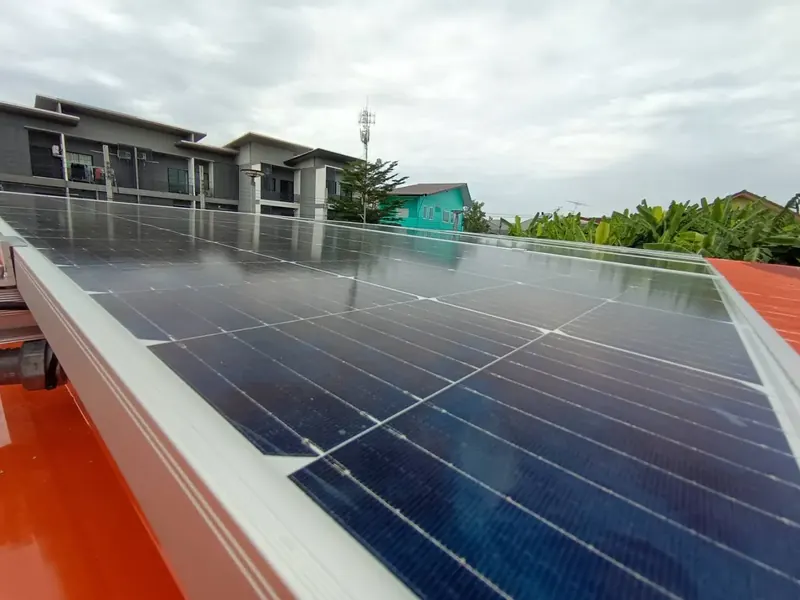
Questions about batteries always come with one misconception: that adding a battery will save you much more on electricity. That is only partly true, and the numbers usually don't work out.
What does a battery actually do?
A battery does two things. First, it stores surplus power produced during the day for use at night. Second, it keeps power flowing during a power cut.
The first sounds good, but you have to look at all the numbers. Without a battery, surplus power flows out to the grid at a buy-back rate of around THB 2.20 per unit. With a battery, it is stored and used instead of power you would buy at around THB 4.20 per unit.
So the difference a battery makes is about THB 2 per unit, not THB 4.20 — and that difference has to be set against the price of the battery and its limited lifespan.
In most cases, if your only goal is a lower bill, putting the money you would spend on a battery into more panels gives a bigger return.
So when is a battery worth it?
It is worth it when what you are buying is not electricity savings but protection from the damage a power cut causes — which in some cases is worth a great deal.
- Homes with a patient who relies on medical equipment that must not stop, such as an oxygen concentrator
- Aquaculture farms that need aerators running constantly — a few hours without power can cost an entire pond
- Shops with freezers holding high-value stock, where a single power cut causes more damage than the battery costs
- Accommodation or businesses in remote areas where power cuts are frequent and slow to be restored
- People who work from home, where a power cut directly affects income
The way we recommend thinking about it
Split the decision into two parts, and don't combine them.
- Part one: is the solar system worth it on its own? If the answer is no, adding a battery won't make it worthwhile.
- Part two: how much do power cuts cost you per year? Compare that with the battery's price divided by its lifespan.
- If the part-two figure is higher, the battery is worth it. If it is lower, put the money into more panels or keep it.
Cheaper alternatives
If your only goal is protection from power cuts and you don't need to store daytime power, a backup generator is usually much cheaper for the same output. The drawbacks are noise, refueling and having to start it yourself.
Another option is a small battery that keeps only the essential circuits running — such as the refrigerator, lighting and a few sockets — instead of the whole house. This cuts the cost substantially and works well in practice.
Frequently asked questions
Can a battery bring my electricity bill to zero?
In theory, yes, with enough panels and a large enough battery — but the cost would be so high that payback becomes too long to be worthwhile. Most homes therefore reduce their bill as far as it makes financial sense and pay the rest.
Are batteries safe? Can they be installed inside the house?
Lithium batteries for this purpose have a built-in battery management system that shuts them down if anything is abnormal. But the location matters a great deal: it must be well ventilated, not too hot, not damp, and not on an escape route. We plan the location during the site survey.
Related services and areas
Keep reading
- On-Grid, Off-Grid or Hybrid Solar: What's the Difference and Which Suits You?The difference comes down to whether the system connects to the utility grid and whether it can store power — which changes both the price and the value.
- Is Solar Worth It for Cold Storage and Ice Plants?Compressors that run all the time are the load that absorbs daytime solar power best — and cold storage is a core industry in Songkhla and Nakhon Si Thammarat.
- Does Solar Still Work During a Power Cut?Many people only find out at their first power cut that the house goes dark as usual, even with bright sun on the roof. Here's why, and what you need if you want power to keep running.