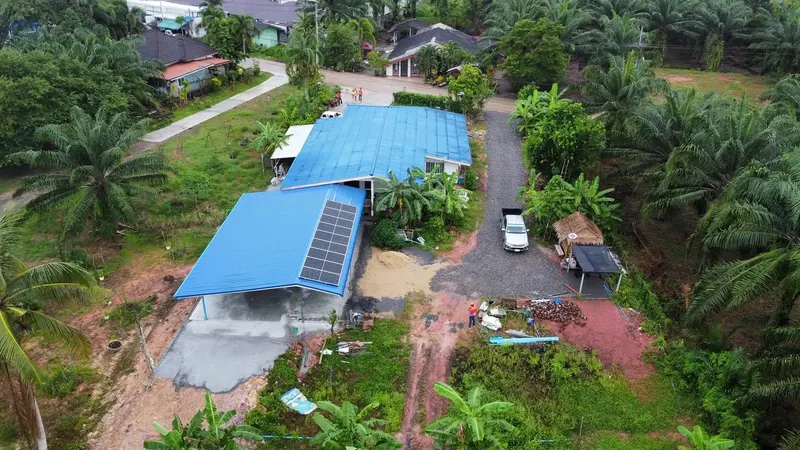
People who live in a housing estate, a townhouse or a condominium usually hit the same question before they get to system size: whose permission do I need? The answer depends on who legally owns the roof you want to use, and whether community rules apply on top of that.
This article goes through each case, with the Thai laws involved as far as we could verify them from official sources. Details that vary from one project to the next have to come from the regulations of your own juristic person — the legal body that manages a condo building or a housing estate.
At a glance: who you need to agree with
| Property | Who owns the roof | Who to agree with first |
|---|---|---|
| Detached house in a housing estate | The homeowner | Check whether the estate's juristic person requires notice or approval |
| Townhouse or semi-detached house | Each owner, but the roof and walls may run into the neighbor's | Estate rules, plus the neighbor if the work touches shared parts |
| Condominium | Common property of all co-owners | The condominium juristic person and a co-owners' general meeting |
| Rented house or villa | The landlord, not the tenant | The landlord, in writing |
Condos: the roof does not belong to any single unit owner
Thailand's Condominium Act of 1979 (B.E. 2522) defines common property as the parts of the building that are not units, the land the building stands on, and other land or property kept for the shared use or benefit of the co-owners. Section 15 lists the building's structure — the parts that keep it stable and protect it from damage — as common property.
The roof and roof deck are therefore not part of anyone's unit. The owner of a top-floor unit cannot decide to install panels alone, even if their unit sits directly under the roof.
A general-meeting resolution is required
Section 48 of the same Act (as amended by the Condominium Act No. 4 of 2008) requires certain resolutions to carry at least half of the total votes of all co-owners. Two of them apply directly to solar:
- Allowing a co-owner, at their own expense, to build, decorate, improve, alter or extend their own unit in a way that affects common property or the building's exterior
- Construction that alters, adds to or improves common property
If the first meeting does not reach that threshold, the law says a new meeting must be called within 15 days, and at that meeting the resolution needs at least one third of the total votes of all co-owners.
Each building's own regulations may add steps — for example, items that must go through the committee before reaching the general meeting, or conditions on using the roof deck. Ask the building office for the current regulations before you start talking to installers.
Which meter would a condo roof system feed?
Grid-connection applications are made in the name of the meter holder. Each unit has its own meter, while corridor lighting, lifts, water pumps and other shared systems run on a meter in the juristic person's name. Running cables from the roof down to one particular unit means passing through several floors of common area, so it has to be clear from the start whose meter the system will connect to and who will apply to the utility.
The roof deck itself also needs checking. It often already carries waterproofing and building equipment such as water tanks, air-conditioning units or antennas, so the usable space may be smaller than it looks on the plans, and an engineer has to certify that the structure can take the extra load.
Detached houses in a housing estate: your roof, but check the rules
A house in a housing estate belongs to its owner. The estate's juristic person looks after the shared facilities, such as the roads and common areas.
That said, Section 48 of the Land Allocation Act of 2000 (B.E. 2543) gives an estate's juristic person the power to set rules on the use of shared facilities and on residence and traffic within the estate. So your estate's rules may include things that affect an installation, for example:
- Notice or approval before renovation or extension work
- Requirements on the external appearance of houses
- Days and hours when contractors may work, and registration of workers entering the estate
- Rules on delivery trucks or cranes, and on leaving materials on shared roads
None of this is standard across estates. The simplest step is to ask the estate office whether there is a work-notice form, and file it before installation day.
If the estate has not yet registered a juristic person, the developer or the project's management company may still be looking after the shared facilities — ask the project office instead. The Land Allocation Act (No. 3) of 2025 (B.E. 2568) took effect on 1 March 2026; for the current text, check with the local Land Office.
Townhouses and semi-detached houses: shared walls and roofs
In many townhouse projects the roof runs continuously across several houses, and each house shares a wall with the next. That calls for more care than a detached house in three areas:
- Roof boundaries: panels and mounting rails must stay on your section of the roof. If the crew needs to work on the neighbor's section, the neighbor has to agree first.
- Rainwater: joined roofs often have gutters or joints that carry water from several houses. A fixing point in the wrong place can send water toward the house next door.
- Cable routes: cables from the panels to the inverter should run on your side, not across the shared wall or the neighbor's property.
If the work does touch a shared part, put the agreement with your neighbor in writing, and have the installer check the actual roof boundary during the site survey rather than working from photos.
On roof leaks: our 2-year installation warranty covers leaks from the points where we fix the mounting structure. Leaks from other parts of the roof, or from existing wear, are outside it. If a townhouse roof is old or has had problems at the joint with the neighbor's roof, get that repaired before the panels go on.
Rented homes: the landlord has to agree
A tenant can install solar if the landlord agrees, but several documents the utility asks for have to come from the owner, such as proof of building ownership. If the meter is in the landlord's name, a letter of consent from the meter holder is needed as well.
Get the landlord's agreement in writing, and settle what happens when the lease ends — whether the system stays with the property or the tenant removes it. If only a few years remain on the lease and this is not yet agreed, sort it out before you invest.
The documents the PEA asks for, wherever you live
All of Southern Thailand is served by the PEA (Provincial Electricity Authority). These are the documents the applicant prepares:
- A copy of the meter holder's identity document
- A copy of the house registration for the installation address
- A recent electricity bill showing the customer account number
- Building ownership documents, e.g. the title deed or sale contract
- Company registration certificate (only if the applicant is a company)
- A power of attorney, if the installer files on your behalf
The names on the documents must match the meter holder. If they do not, a letter of consent from the meter holder is needed. Where the applicant is a condominium juristic person, any extra documents the local PEA office requires have to be checked case by case.
The juristic person's consent or the co-owners' resolution is not on the utility's document list, but you need it before any work starts. If an installation is challenged afterwards, the whole system may have to come down.
Suggested order of steps
- Confirm who owns the roof and whose name the meter is in
- Get the current regulations from the juristic person and look for work notices, appearance rules or contractor hours
- For a condo, submit the proposal to the committee or building manager so it can go on the general-meeting agenda
- For a townhouse or rented home, talk to the neighbor or landlord and put the agreement in writing
- Have the installer survey the site: roof boundary, cable route, inverter location and structure
- Prepare the utility paperwork, then book the installation
Summary
In a housing estate, a detached house's roof is yours and the main task is following the estate rules. Townhouses need care with boundaries and anything shared with the neighbor. Rented homes need the landlord's consent. In a condo the roof is common property, so it goes through the juristic person and a general-meeting resolution. Settle these before installation and you avoid problems later.
This article summarizes the law to give an overview. It is not legal advice for any specific case. If there is a dispute, or the regulations can be read more than one way, consult the juristic person, the Land Office or a lawyer.
Sources used for this article
Figures in this article are based on public announcements and news reports (most sources are in Thai). If the conditions change, the latest official announcement from the relevant authority applies.
Frequently asked questions
I own a top-floor condo unit. Can I put panels on the roof above it?
Not on your own decision. The roof and building structure are common property under the Condominium Act, and construction that alters or adds to common property needs a co-owners' general-meeting resolution with the votes the law requires. Start by submitting the idea to the condominium juristic person.
Do I need the estate's permission for a detached house?
The roof is yours, but the estate's juristic person has the power to set rules on residence within the estate. Some estates want notice before work starts; some set contractor hours. Ask the estate office which forms or steps apply.
Can a housing estate ban solar panels?
That depends on the estate's own regulations and how they are interpreted legally, which we cannot answer on behalf of the juristic person or a lawyer. What you can do is ask to see the regulations in force and talk to the juristic person before work begins. If appearance is the concern, the installer can propose a neat panel layout and cable route.
My townhouse roof joins the neighbor's. Do I need their consent?
If all the work stays on your section of the roof and does not touch shared walls or gutters, it is your own matter. If the crew has to work on the neighbor's roof or alter anything shared, you need the neighbor's consent first, ideally in writing.
I rent my house or villa. Can I install solar?
Yes, with the landlord's written consent. The utility asks for building ownership documents, and if the meter is in the landlord's name, a letter of consent from the meter holder too. Agree what happens to the system when the lease ends.
Related services and areas
Keep reading
- Will Solar Panels Make My Roof Leak? Installation Methods That Protect Your RoofIt is homeowners' number-one worry, and a reasonable one: drill points that are not sealed correctly really can cause leaks.
- 7 Things to Check Before Choosing a Solar Installer in Southern ThailandThe cheapest price is not necessarily the best value, and the most expensive is not necessarily the best. Here is what to look at instead.
- How Long Does Solar Installation Take, From Signing to Switching On?The installation itself takes only a few days, but the paperwork with the utility takes months. Many people assume the system can be used as soon as it's installed.
- Single-Phase vs Three-Phase Power: Do You Need a New Meter for Solar?Your home's power supply sets how big a solar system you can install — and it's worth knowing early whether you need a new meter, which is a separate cost.