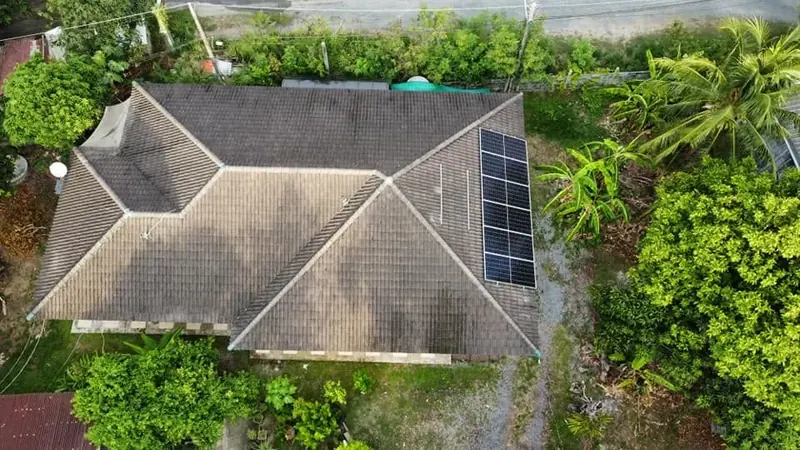
Once you have decided to install, the next question is what size. That decision affects your return more than the choice of panel brand does.
A quick reference table
This table assumes a home where someone is in for part of the day, using around 40 to 50% of its electricity in daytime hours. If your home is empty all day, go one size down; for a shop that is open during the day, go one size up.
| Monthly bill | Units per month | Suitable size | Roof area |
|---|---|---|---|
| THB 3,000 | ~714 kWh | 3–4 kW | ~17–22 m² |
| THB 5,000 | ~1,190 kWh | 5–6 kW | ~22–27 m² |
| THB 8,000 | ~1,905 kWh | 8–9 kW | ~36–40 m² |
| THB 10,000 | ~2,381 kWh | 10–12 kW | ~45–54 m² |
| THB 20,000 | ~4,762 kWh | 20–24 kW | ~90–107 m² |
These figures are only a starting point. The real size has to come from your past bills and a look at when you use electricity. Two homes with the same bill can need sizes that differ by as much as 40%.
Why oversizing is a bad idea
Many people think it is best to install big to allow for the future. It sounds sensible, but the numbers usually do not work out.
The reason is that any power produced beyond what you can use during the day flows out to the utility grid and earns a buy-back rate of around THB 2.20 per unit, while power you use yourself is worth the full retail price of around THB 4.20 per unit.
In other words, every surplus unit earns you only about half of what a self-used unit does. The extra money spent on the surplus panels therefore pays back much more slowly than the first part of the investment.
What if you will use more electricity in the future?
If you have a concrete plan — you are buying an electric car next year, or adding an air-conditioned room — then allow for it. But plan for it specifically, not just in case.
The option that usually pays off better is to install the size that suits you today and design the system for expansion from the start: choose an inverter with enough capacity to take more panels, and lay out the roof so there is space to add them. That way you can add panels later without throwing away the inverter.
How an electric car changes the equation
If you own an EV and can charge it at home during the day, it is one of the best possible loads for solar, because it is a large load whose timing you can move freely.
But if the car is out at work during the day and you charge it at night, the EV does nothing to make solar more worthwhile, because you are charging when the panels are no longer producing. In that case you would need a battery to store daytime power for the night, which adds a lot of cost and needs its own calculation to see whether it pays off.
How much roof area you need
Current high-output panels of around 625 W take up about 2.8 square meters each. A 5 kW system uses 8 panels, so it needs roughly 23 square meters.
But the usable area has to be free of shade during the day, and ideally be one continuous section or face one direction. Spreading panels across several directions is possible, but the system has to be designed for it; otherwise the panels getting less sun drag down the output of the whole set.
Frequently asked questions
Can I install smaller than recommended if my budget is limited?
Yes — and it is often a better choice than borrowing more to install a bigger system. A small system that uses every unit it produces gives a better return per baht invested than a large system producing more than you need.
My roof isn't big enough. Can I install somewhere else?
Yes. A common option is a solar carport roof over the parking area, which both generates power and shades your car. Another is the roof of a storage shed or other service building on the same property.
Related services and areas
Keep reading
- Is Solar Worth It in Nakhon Si Thammarat? Working It Out From Your Real BillMost people ask how high a bill has to be before solar pays off. Just as important is when you use electricity, because panels only generate during the day.
- 7 Things to Check Before Choosing a Solar Installer in Southern ThailandThe cheapest price is not necessarily the best value, and the most expensive is not necessarily the best. Here is what to look at instead.
- Thai Electricity Is THB 3.95 per Unit for Sep–Dec 2026 — How to Calculate Solar Payback CorrectlyThe tariff you see in the news and the rate you actually pay are not the same. Here's how to work out your own real cost per unit so your payback calculation is accurate.
- Single-Phase vs Three-Phase Power: Do You Need a New Meter for Solar?Your home's power supply sets how big a solar system you can install — and it's worth knowing early whether you need a new meter, which is a separate cost.