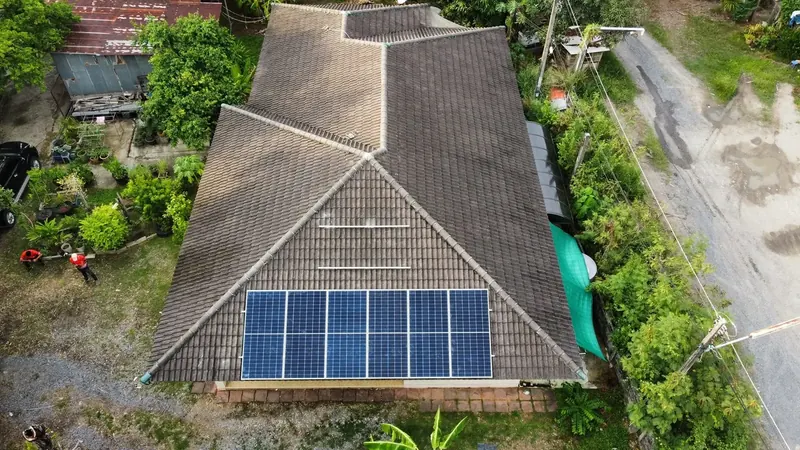
In the first month after installing solar, many owners open their bill and are surprised there is still something to pay. For some the drop is smaller than expected; for others the bill falls sharply one month and climbs again the next.
A standard on-grid system is designed to reduce your electricity bill, not to eliminate it, so a remaining bill is normal. The useful questions are where the remaining bill comes from, and whether that matches what was calculated.
1. Power at night is still bought from the grid
Panels only generate while there is daylight, roughly 8 a.m. to 5 p.m. Anything used after sunset — bedroom air-con, lighting, the fridge overnight — still comes entirely from the utility unless you have a battery.
Homes that use a lot of power at night therefore see smaller reductions than homes that use it in the daytime, even with the same size of system. If several bedroom air-conditioners run all night, that is usually the largest part of what remains on the bill.
2. Service charge, Ft and VAT
Your bill is more than an energy charge per unit. There is a monthly service charge that applies however much or little you use, the Ft (fuel adjustment charge) applied to each unit you buy, and 7% VAT on the total.
The Ft is reviewed every four months. If it goes up, the amount you pay may not fall as much as expected even though the units you buy have dropped. The more reliable comparison is the number of units on the bill, not the baht total.
3. Rainy and monsoon months produce less
The figure of 1,350 units per kWp per year is a full-year average; it is not spread evenly across the months. In months with several days of continuous rain, the system produces clearly less than average and the building buys more power from the grid.
- On the Gulf of Thailand side — Nakhon Si Thammarat, Songkhla, Hat Yai — the heaviest rain comes late in the year with the northeast monsoon.
- On the Andaman side — Phuket, Krabi, Phang Nga, Trang — the heavy rain comes mid-year with the southwest monsoon.
Judge whether the system is worthwhile over a full year, not from one monsoon-month bill.
4. Exported power is not netted off unit for unit
Around midday, when the building uses little, surplus power flows out to the utility grid — and in the evening the building buys power back. Many people assume the two cancel out. They don't.
If you have a place in the residential buy-back program (Solar Phak Prachachon), exported power is credited separately at THB 2.20 per unit, while the power you buy is still charged at the full rate. If you are not in the program, exported power earns nothing. A home that exports a lot in the day but uses heavily at night will still see a sizeable bill.
5. The system is smaller than your use — or your use has grown
A system sized to match daytime demand is not meant to cover everything the building uses. That is deliberate: an oversized system sends surplus power out at a low price.
Another common case is consumption rising after installation — running the air-con longer because the power feels free, adding air-conditioners, or starting to charge an EV overnight. Total units go up, so the bill falls less than expected even though the system is producing normally.
6. Shade and dirt on the panels
Trees that grow taller, new buildings next door, bird droppings and algae along the panel frames all reduce output a little at a time, with no warning. In the South, rain washes off some dust, but it does not remove bird droppings or algae.
7. The inverter trips, or the app loses connection
Inverters shut themselves down for several reasons: overheating in a poorly ventilated spot, abnormally high grid voltage during the day, or not restarting after a power cut. If this happens often or lasts several days, that month's bill rises straight away.
A case that looks like a fault but isn't: the app stops updating because the Wi-Fi password or router was changed. The system keeps producing normally; it just can't send data. Check the status lights on the inverter itself as well.
Four checks in the app before concluding something is wrong
- Look at the month's generation in units and compare it with a rough average of kWp × 1,350 ÷ 12. A 5 kWp system averages about 560 units a month — lower in monsoon months, higher in sunny ones.
- Pick a day that was sunny all day. Peak output around midday should be about 75–85% of kWp. If it is well below that, it's worth having the system checked.
- Look at the shape of the daily curve. If it drops out for periods and comes back, or falls only in the afternoon, there is a specific cause to find.
- If the app shows self-consumption, export and grid purchases separately, check when most of the purchased power happens. If it is mainly at night, the system is working normally and the remaining bill comes from night-time use.
Some on-grid systems are installed with the inverter only and no meter measuring the building's consumption. The app can then show generation only, not self-consumption or grid purchases. If you want the full picture, ask your installer whether a monitoring meter can be added to your system.
| What you see | Usual cause | What to do |
|---|---|---|
| Normal generation, but the bill is still high | Heavy night-time use, or consumption has grown | Compare the units on your bill with last year; shift some loads into the daytime |
| Low generation only in rainy months | Weather | Judge by the full-year total instead of month by month |
| Generation slowly falling month after month | Dirty panels, or growing shade | Clean the panels and check for anything blocking the sun |
| The curve drops out repeatedly | Inverter tripping on heat or voltage | Note the alarm code in the app and call a technician |
| Zero generation for several days | Inverter stopped, or the app has lost connection | Check the status lights on the unit; if it has really stopped, call a technician straight away |
If your checks show generation clearly below what it should be on sunny days, or an alarm code that won't clear, have a technician inspect the system. Systems we install include panel cleaning and an annual system check for the first 2 years, and we can also inspect systems installed by others.
Frequently asked questions
Can solar bring my electricity bill to zero?
With a standard on-grid system, almost never — night-time power still has to be bought, and the monthly service charge applies every month. Cutting night-time use requires a battery, which adds considerable cost and needs its own calculation to see whether it is worthwhile.
This month's bill is higher than last month's. Is the system faulty?
You can't tell yet. Compare units rather than baht, then check the month's generation in the app. If generation is similar to the previous month, the cause is usually higher consumption or a change in the Ft. If generation has clearly dropped while the weather was similar, that is the signal to have the system checked.
Why don't my billing period and the app's figures line up?
The utility's meter-reading dates don't always fall on the 1st to the end of the month. When comparing, set the date range in the app to match the meter-reading dates on your bill.
My bill goes up every monsoon season. Should I add more panels?
Usually not. If you add panels for the monsoon months, the sunny months will have surplus that flows out at a low price or for nothing, which lengthens payback. The right size is the one based on the full-year average.
The app shows no data, but the inverter lights are on. What should I do?
It is usually an internet connection issue, such as a changed Wi-Fi password or a new router. The system is still producing. Reconnect it following that brand's manual, or ask your installer to help set it up.
Related services and areas
Keep reading
- Why Is My Solar Output Dropping, and Can I Check It Myself?Solar systems rarely die completely. More often they slowly produce less with no warning — and the way to catch it is to look at your generation history.
- How Often Should You Clean Solar Panels, and Why Is the South Different?Rain washes off dust, but not bird droppings or algae — and a small patch of grime cuts output more than a thin film of dust spread across the whole panel.
- It Rains a Lot in Southern Thailand — Does Solar Still Produce Real Power?Solar panels run on light, not heat, so they still generate on overcast days. But how much less do they produce, and is it still worth it?
- kW vs kWp vs kWh: The Solar Units on Your Quote, ExplainedA solar quotation is full of look-alike numbers — kW, kWp, kWh. Mix them up and your price comparison is wrong from the start. Here is what each one actually measures.