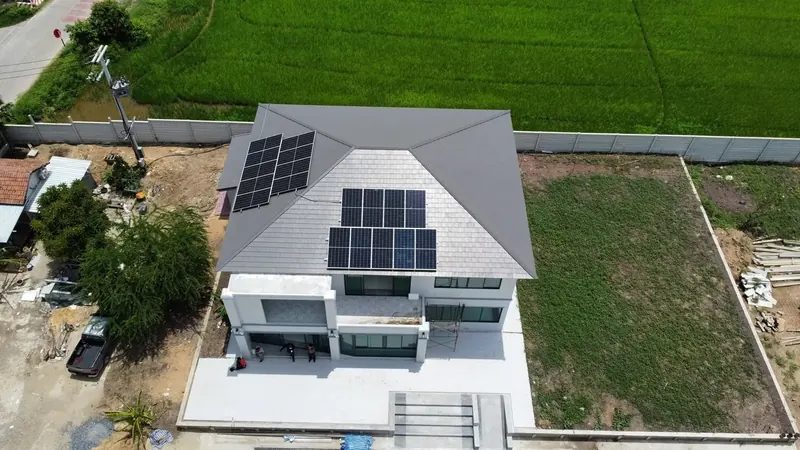
A grid-connected solar system needs the electricity meter replaced with one that handles power flowing in both directions. That cost appears in almost every quote, so it's worth checking against the current rates.
The Provincial Electricity Authority (PEA), which supplies power everywhere in Thailand outside Bangkok and its neighboring provinces, has issued new meter installation fees, published in the Royal Gazette and effective from February 23, 2026. They start at THB 3,300 and go up according to meter type and size.
Why this matters to you
The old figures, set under the 2019 rules, ranged from THB 8,500 to about 9,000.
If your quote budgets the meter using the old figure, you can ask for it to be updated to the current rate.
The published rates cover many meter types and sizes, from THB 3,300 up to the tens of thousands for large meters. The figure that applies to your home depends on your meter type and size, so ask your installer to state clearly which meter type they will apply for.
How to check your quote
- Check whether the meter replacement cost is listed as a separate line. If it's lumped into one figure with the handling fees and not broken down, ask for it to be itemized.
- Ask which meter type and size will be applied for, since the price depends on it.
- Ask whether you'll be charged what PEA actually charges, with a PEA receipt, or a flat fee.
- If it's a flat fee, ask what it covers.
Paperwork costs that should be in your quote
Besides the meter, there are other items related to permits. It helps to have the quote state clearly who is responsible for each one.
- Handling the application to connect the system to the grid.
- The engineer who certifies the design and the structural calculations.
- Notifying the local authority as required by law.
- Fees for joining a power buy-back program, if you choose to join.
We itemize these for every customer, so you can see exactly what each fee covers.
Sources used for this article
Figures in this article are based on public announcements and news reports (most sources are in Thai). If the conditions change, the latest official announcement from the relevant authority applies.
Frequently asked questions
If I had my meter replaced before February 2026, can I get the difference refunded?
The new rates apply to service requests from the effective date onward. If you paid before then, ask the PEA branch where you applied directly — we'd rather not give information that might not apply to your case.
Does installing solar always mean switching to a three-phase meter?
Not always. It depends on the system size and your home's existing supply. A home already on single-phase power installing a modest system may not need to switch to three-phase. That decision should come from an actual site survey, not an assumption that every home has to change.
Related services and areas
Keep reading
- 7 Things to Check Before Choosing a Solar Installer in Southern ThailandThe cheapest price is not necessarily the best value, and the most expensive is not necessarily the best. Here is what to look at instead.
- Thailand's 2026 People's Solar Program: Selling Power Back at THB 2.20 — Is It Worth It?The program is real and so are the terms, but the THB 2.20 the state pays is almost half what you pay for power yourself. Here's how much selling back actually earns — and why it isn't the main reason to install solar.
- Monthly Bill of THB 3,000, 5,000 or 10,000 — What Size Solar System Do You Need?The best-value size is not the largest your roof can hold — it is the size that matches the electricity you use during the day.
- Single-Phase vs Three-Phase Power: Do You Need a New Meter for Solar?Your home's power supply sets how big a solar system you can install — and it's worth knowing early whether you need a new meter, which is a separate cost.